


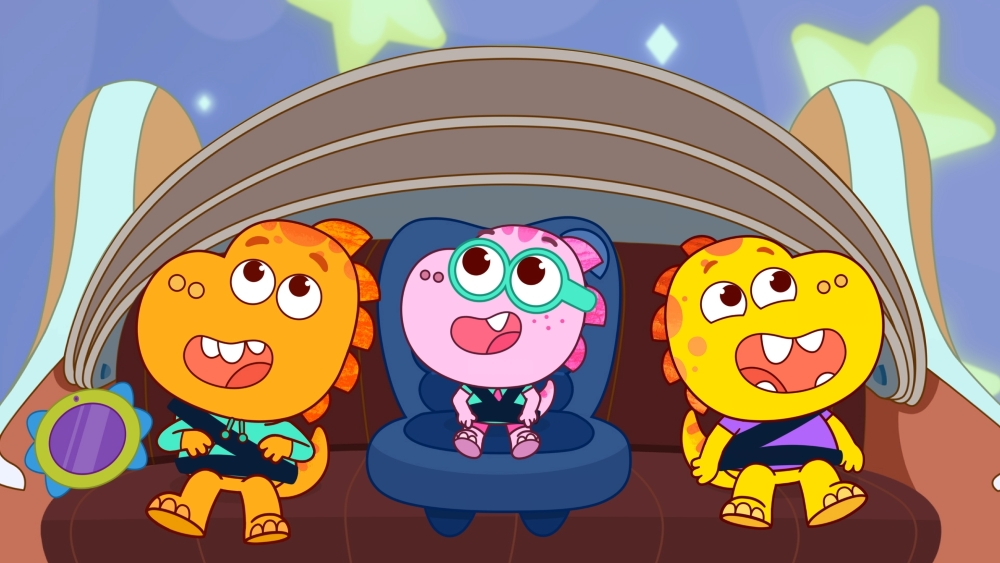


Combining two obsessions of every young child — dinosaurs and space — the preschool series Tim Rex in Space looks to use its adventures to create curiosity about the everyday.
The co-production between Nickelodeon, Mint Copenhagen and Milkshake! (by the U.K.’s Channel 5), and animated by U.K.- and Ireland-based JAM Media, is directed by Sam Dransfield (who previously worked on Nickelodeon’s Bossy Bear). The series is about a T. rex named Tim, his siblings and his friends, all of whom live in Rumbleton — a town built across a series of interconnected asteroids.

Intergalactic Spin
Head writer Andy Potter (Sharkdog, Class Dismissed) emphasizes that despite the outlandishness of the premise — a family of dinosaurs in space — “We really tried to ensure that Tim felt like a real kid, experiencing the true emotions, problems and dilemmas that our young audience would recognize, albeit with an intergalactic spin.” Dransfield concurs and expands on their goal of fusing two wondrous topics that have long been compelling to children. With a clear concept in place, they had to build around “that heart to the show, which is Tim himself, and then that allows you to explore this combination,” the director says. “Equally, we were keen that comedy should always be front and center,” Potter adds, “and to include gags that would resonate with children and parents, so families would catch moments in each episode where they’d think, ‘Yep, that’s just like us.’”
That balance, of course, also influenced the show’s art direction. Series designer and art director Joshua Hogan says it was a “tough one to [figure] out at first,” as the premise gave them so many possibilities that it was hard to narrow it down. What helped was to pair their initial idea — bold colors and expressive characters — with what Hogan describes as “the simplified, rounded shapes seen throughout both the character designs and environments.” He continues, “It helped us build a whimsical universe that feels both fresh and familiar at the same time. Not too futuristic but also not too ordinary.” Dransfield says they also took early steps to make the show feel “more terrestrial” to keep the young audience on familiar soil. Experiments with colors were attempted in visual development, but eventually it was decided that, in this case, the grass should be green, the sky blue.

“That’s hopefully what the series achieves: where you see a little asteroid in the title sequence up in the corner and [think] perhaps the episode is going to be about whatever’s on that asteroid.”
— Series director Sam Dransfield
Episode director Jess Patterson (Nova Jones) explains how this translated into the animation: “As Tim Rex in Space is an action-packed series with a lot of heart, we focused on combining natural movement and acting with some more cartoony elements when looking at the animation style.” Those cartoony elements often came in by using 2D techniques. “We wanted the characters to feel energetic, lively and fun while also maintaining a solid sense of their weight (so some screen-shaking dino-stomps wouldn’t feel out of place). As a result, we often work in some smears, zips and pops between poses where we feel they would add to a moment or shot.”
Patterson says the team worked in “an almost ‘2.5D’ style of animation,” which allowed some experimentation in each episode. The team also had to do some problem-solving for the more realistic elements or, as Patterson puts it, “the big-head-little-arms question that comes with working with dinosaurs.”

“The simplified, rounded shapes seen throughout both the character designs and environments helped us build a whimsical universe that feels both fresh and familiar.”
— Series designer and art director Joshua Hogan
Dransfield adds, “In designing these characters that look quite flat, we don’t have a lot of turnaround angles of their heads. So when Tim, for instance, turns from facing one way to facing the other, there’s a bit of a snap because his head isn’t 3D, so we can’t show it rotating all the way around.”

This created a limitation because “Tim lives in a 3D world and he moves in 3D,” Dransfield says. He continues, “We can have characters move towards camera and move away from camera, and they move like 3D characters, but at their core, they are 2D, and I think the success of that approach is a testament to the achievements of both the character designers to begin with, and then also our incredible animation teams over at JAM in Belfast.”
The solutions, Patterson says, came from the designers at Mint as well as the rigging and animation teams at JAM Media. “[They] have consistently hit it out of the park in terms of what we can achieve with the character rigs, props and vehicles,” she says. “From lovely subtle expression changes and quiet moments of character acting to breakdancing robots and multi-rocket space races, the teams somehow manage to outdo themselves time and time again.”

The Right Amount of Surreal
Like the art direction, using the stylized animation carefully was also important. Having been a storyboarder on shows like The Tom & Jerry Show, Dransfield is a professed fan of golden age animation, but Tim Rex was an exercise in restraint. “I don’t think it’s always totally appropriate for preschool viewers, who are brand new to cartoons, to kind of throw them in on the deep end of that kind of surrealism which that style of cartooning lends itself to,” Dransfield says, adding that the series would apply that cartoony visual language with a light touch. Dransfield also acknowledges the flipside of this, that it was also important to challenge the young audience, at least a little. “You shouldn’t be talking down to them. They are a more advanced audience than you might initially think,” the director says about managing the tone as well as the animation.
But even with that need to turn the dial down a little, building a sense of wonder was still important. Dransfield points to an early piece of visual development, a map of Rumbleton. “We were pulling from children’s illustrations and classic kids’ books, which quite often have these kind of busy, detailed worlds — like the books from your childhood where you remember poring over those images for hours. And so that’s what we really tried to do with that map. That’s hopefully what the series achieves: where you see a little asteroid in the title sequence up in the corner and [think] perhaps the episode is going to be about whatever’s on that asteroid.” With its combination of space and the familiar touches of home life, Tim Rex aims to be a show that is universal in two senses of the word.
Tim Rex in Space airs on Nickelodeon Monday-Thursday at 9:30 a.m. and encores on Nick. Jr. at 6:30 p.m. The show also airs on Nick channels internationally and on Milkshake! in the U.K.