

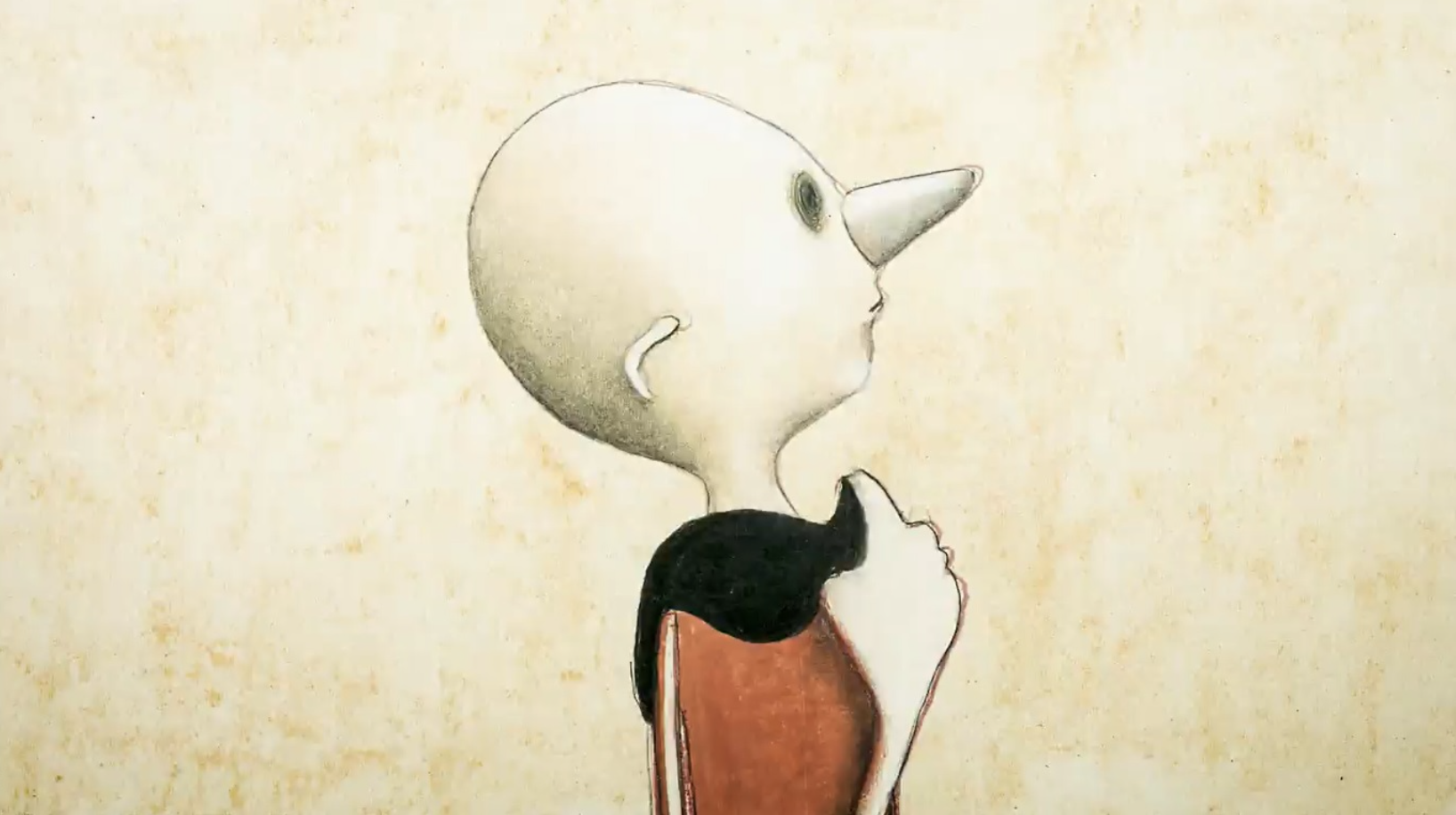


Last Saturday, Roberto Catani’s Il Burattino e la balena (The Puppet and the Whale) took home the Grand Prize for Best Animated Short at the Ottawa International Animation Festival, making it automatically qualified for Oscar consideration. The short, which is produced by Miyu, La Sept and Withstand Films, is a surreal meditation on Pinocchio, centering on a haunted puppet who doesn’t quite become a boy.
The festival judges praised the short’s “ability to work with image, movement and sound,” and liked the fact that it worked with an iconic character to pose important questions about conformity and society while remaining open-ended in its inventive approach. We were fortunate enough to catch up with the talented Italian illustrator, animation director and teacher to find out more about his memorable new project.

“I started developing the idea for the film in 2019, but the visual and conceptual work began the following year,” Catani tells us. “The film, which has evolved considerably from its first version, took about two and a half years to complete — a period that would have been much longer without the support of two essential collaborators, Viola Mancini and Mariangela Malvaso, as well as the presence and encouragement of a committed production team.”
The idea of working with the character of Pinocchio originated from a desire to tell the story of a figure who refuses to conform to the human model, in both the political and social sense of the term, the filmmaker explains. “This is a model he is ultimately destined to become, however,” he points out. “The film attempts to express a rejection of a humanity that has lost its innocence and purity, its capacity for wonder, and has instead become cynically subservient. Pinocchio performs a gesture of rebellion against the human (and particularly adult) world that tries to impose its structure on him — drawing inspiration above all from Jean Vigo’s magnificent film Zero for Conduct.”

Catani whose previous festival favorites include The Tightrope Walker (2002), Absent Minded (2013) and Per Tutta La Vita (2018) prefers to use traditional hand-drawn animation to tell his stories. “All the drawings were made on paper and colored with mixed media — chalks, graphite, pastels, Oilbar, acrylics, drypoint, and more — always on paper,” he notes “The photography and editing phases, however, were carried out digitally.”
The artist says his approach to animation comes from a creative path that began many years ago, when he attended the state Art School in Urbino. “I began that journey at the age of 14, in an environment that celebrated image-making through research and formal experimentation,” Catani recalls. “We were not trained specifically in animation, but more broadly in the language of visual art in all its forms.”

As a teen, Catani remembers skipping schools with his friends to attend his first animation festival. “It was in Lucca, Tuscany — far from our school — and it was there that I saw, for the first time, the films of an artist who profoundly changed my perception of animation: Yuri Norstein, the Russian master,” he mentions. “I fell in love with his work then, and I still love it today. Over time, many other films and artists have shaped my vision of cinema and visual expression. Perhaps the artist who most influenced my personal path was Ursula Ferrara. Her beautiful films inspired me deeply and opened up expressive and poetic possibilities that felt very close to my own idea of cinema.
 For many years, Catani has enjoyed teaching hand-drawn animation to students in public schools. “With my students, year after year, I explore the language and themes of animated cinema,” he says. “I show them films and lead workshops designed to introduce young students to the techniques and expressive potential of drawn animation. These are long processes, usually spread over three years. This ongoing teaching work keeps me closely connected to the world of animation every day.”
When asked about the state of animation in the world today, Catani remains quite optimistic. “Although it lives in the undergrowth of ‘cinema,’ animation remains a highly vibrant form of expression, and I believe it’s still one of the most fertile grounds for technical, formal, and poetic experimentation in contemporary film,” he says. “Animation continues to be a space for reflection, poetic language, and meaningful exploration — a space where we can resist the superficiality and banality imposed by dominant political and economic systems.”
Pinocchio’s new puppetmaster leaves us with these words. “I’m not really in a position to give advice to young artists, but if I had to share one suggestion, it would be this: Make animation only if it feels like a necessity — an urgent need that overrides everything else!”
For more info, visit miyu.fr/distribution/en/il-burattino-e-la-balena-2.