


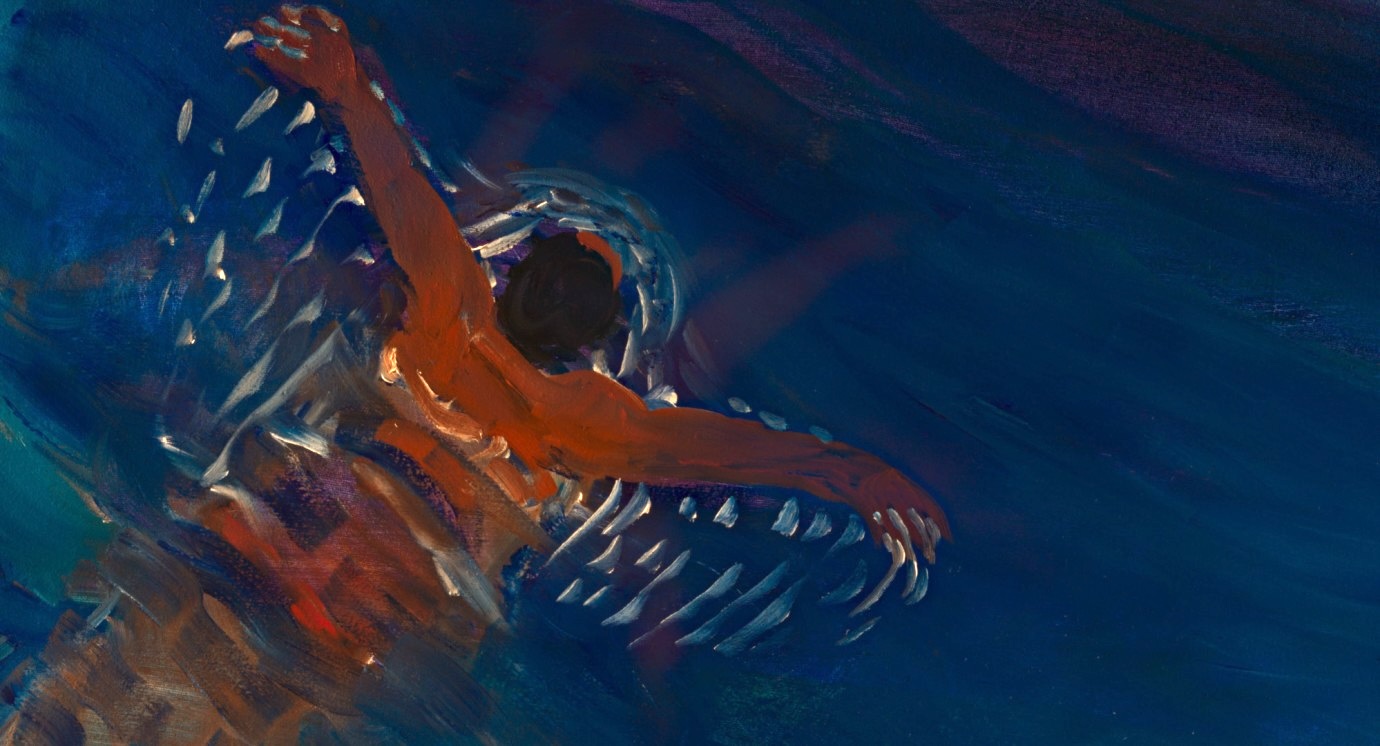

French animation director, writer and artist Florence Miailhe has been a familiar figure on the global animation scene with acclaimed shorts such as Conte de Quartier, Hammam and her stunning 2021 feature The Crossing (created by using oil paintings on glass). This year, the brilliant artist delivered another powerful animated short titled Papillon, which received a César nomination (French Academy Award), a Cristal nomination at Annecy and the Grand Prix at Stuttgart which also qualifies it for Oscar consideration. This beautifully crafted, poetic short is inspired by the life of Alfred Nakache, a French swimming champion that was deported during the Second World War. Nominated for a César earlier this year (French Academy Award), Papillon is produced by Oscar-winner Ron Dyens (Flow, Sirocco and the Kingdom of the Winds, Portraits de Voyage) and features music by Pierre Oberkampt. Miailhe was kind enough to answer a few of our questions about her new creation:
Animation Magazine: Can you please tell us a bit about the beginning of the project. When did you decide to tell this powerful story in animation?
 Florence Miailhe: I was preparing my feature film The Crossing, the project was moving forward, but we were struggling to find the necessary funding, and at one point, I began to lose hope. I told myself that maybe I would have to give up on this film. That’s when I started thinking about a new project, this time for a short film. And then, I don’t really know how brain works, but a memory came back to me: that of Alfred Nakache, whom I had met when I was about ten years old, and whom my father admired a lot.
I remembered that my father knew this swimming champion and always spoke of him with great respect. At the time, I was taking swimming lessons with his younger brother, William Nakache, and at every lesson, my father never failed to remind me: “You know, William, he’s the little brother of Alfred Nakache, the great swimming champion!” And one day, Alfred Nakache came to the lesson. My father was already quite old — I was ten, and he must have been in his fifties — and I remember seeing a man of the same age arrive, and thinking that he was very old for a swimming champion.
My father whispered to me, “That’s Alfred Nakache! Show him how you swim the butterfly stroke!” And so, I found myself having to do two or three swimming strokes in front of him, feeling very embarrassed. So, years later, out of curiosity, I searched for Alfred Nakache on the Internet, and that’s when I discovered this very moving story, which I had never been told, probably because I was too young. I found this story incredible. I also learned that he had died while swimming.

I immediately wanted to tell the story of his whole life through this last swim. Especially since he died only a few miles from where I used to swim as a child. It all seemed obvious to me: telling this story brought together many themes that are dear to me — resilience, transmission, memory, but also political issues, such as the fate of a Jewish swimmer facing adversity. And then there was also this personal connection: I had learned to swim with Alfred Nakache’s younger brother. I almost felt like it was a direct transmission — as if Alfred had taught his brother, who had taught me.
Also, the butterfly stroke… it’s a beautiful stroke, very symbolic.
Finally, there was this connection to water, which I love deeply. I love swimming, I love water. For me, water is a wonderful way of telling stories as it carries memory through fluidity. And then, in animation, water offers something very subtle, very poetic, almost abstract. Representing water also evokes emotion, transformation, transition.It all made sense. It was obvious.
How long did it take to make?
Actually, it happened relatively quickly. I already had in mind how I wanted to tell the story, both in terms of script and narration. It all came together very quickly: writing the script, creating the storyboard… It was obvious to me that the character would dive into the water, and that with each dive, he would recover a memory linked to water. I could really visualize the film.
The production itself took 100 days of animation. There were three of us working on animation and then we had a quick post-production time, so we made the film in a year. Which is very quick… Well, “quick” is relative—it’s animation.

Why do you think this story is such a great fit for your special kind of animation?
Animated painting lends itself very well to what I wanted to do, particularly in terms of transitions. I really enjoy working on these transitions from one state to another, and paint really allows for that. It offers ideal visual continuity for smooth transitions — for example, between memories, eras, or emotions.
Animation also makes it possible to show Nakache at different ages. In a matter of seconds, we can go from an elderly man into a young man. There’s a scene, for example, where we see him swimming as an old man, then he dives underwater, and during the dive, his face gradually becomes younger. This kind of transformation works perfectly in animation.
Another iconic moment is when he dives into the water—symbolically, it’s as if he’s diving into his memories of the Second World War. These are very painful memories, and the water becomes cloudy, brown, gray creating an almost nightmarish atmosphere. The pool becomes a space of suffering, laden with memory.
And then there’s this very abstract scene, which I didn’t even animate myself and it was magnificent. We see him coming out of the water, and instead of returning to reality, he finds himself in a landscape with very striking, almost dreamlike colors. This passage marks a transition, not toward oblivion or a definitive resolution, but toward another stage.
It is really through all these transformations and passages that the link between the different layers of the narrative is woven.

Can you describe the visual style of the movie?
The graphic style of the film is based mainly on oil painting, done directly on canvas. This choice gives the film a very rich texture, with the visible grain of the canvas. The brushstrokes bring a visual density and warmth that was important to me.
I also chose, particularly in the swimming scenes, to focus on movement rather than ultra-precise drawing. When the characters are in the water, we never really see the bodies in their entirety: what matters is the gesture, the movement. Technically, I worked with several layers. To simplify: there was a canvas, with a background, varnished for protection. This protection allows to work directly on the painting, erasing and redrawing movements if needed.
On top of this, a glass pane was placed, onto which layers of oil were added. This is how I made the movements of the water and the deformation of what was under the glass.
The characters were then animated either directly on the background or on the glass whether they were underwater or on the surface. Underwater, they became more abstract, almost blending into the environment. On the surface, they were depicted more realistically.
Color also played a fundamental role. I really enjoy working with color, and for this film, each period of the main character’s life was associated with a particular palette. With the production designer, Margaux Duseigneur, we established a kind of blue chart: sky blue for childhood, turquoise blue for adolescence, navy blue for later life, and a blue verging on purple for the end of his life, when he dives for the last time.
The pools at Auschwitz with dull, muddy, slightly greenish, almost dirty colors. The idea was that each moment of his life, each memory, would be linked to a particular color scheme. All of this has a subconscious effect on the viewer, but it was very carefully thought out.

Did anything surprise you about Alfred’s life as you researched it?
As soon as I came across his story, everything surprised me. It’s an incredible life. But a few things made a deep impression on me. The first is his return from the camps. In 1945, he weighed barely 40 and we’re talking about a top-level athlete here. It’s shocking to imagine a champion’s body in such a state. And the craziest thing is that in 1948, less than three years later, he was selected for the Olympic Games of London. This capacity for resilience is what amazed me the most. He experienced absolute horror, and he came back, swimming again at a world- class level. It’s almost unbelievable.
Then there is a historical element that I was completely unaware of: the revocation of Algerian Jews’ citizenship during the Vichy regime. Algerian Jews had obtained French citizenship thanks to the Crémieux Decree (in 1870). But under Vichy, this nationality was taken away from them, and they became “Indigenes” once again.
Which explains why Alfred Nakache was excluded from French competitions: he was no longer considered a French citizen. This part of colonial and anti-Semitic history really struck me.
Finally, there is a very painful episode that I discovered later, while reading Pierre Assouline’s book. It is not told as such in the film. When Nakache and his family tried to flee to Spain, they returned to Toulouse because their three-year-old daughter was crying too much, and they didn’t want to endanger the people who were helping them escape.
They knew they were taking a big risk, so they entrusted their daughter to friends. But when they were denounced, their daughter was too, so she was deported with them. What we learn is that women arriving at Auschwitz with young children were sent straight to the gas chambers. This terrible detail means that if their daughter had not been arrested, perhaps her mother would have survived.
It’s something I didn’t include in the film, but it moved me deeply.
When I started researching around 2015, there wasn’t much information available about Alfred Nakache. Even in Toulouse, where he made his mark on local history, not everyone knew who he was, despite the swimming pool named after him. I had to dig deep. Today, when you type his name into a search engine, there is much more information available—thanks to works such as those by Pierre Assouline, plays, radio programs, and articles. There has been a real rediscovery.
And recently, he has been inducted in the International Swimming Hall of Fame, spotlighting his story.
And of course, with the rise of Léon Marchand, his story has also resurfaced, as both are strong figures in Toulouse swimming (Léon Marchand learned to swim in a pool named after Nakache and was part of the same swimming club, les Dauphins du TOEC).

Can you talk about the importance of telling the story of Alfred Nakache’s heroic life is so important in our dark days today?
Because I think it’s essential to remember certain historical facts like this one. The story of Alfred Nakache is that of a Jewish man who not only survived the horror, but also led an incredibly heroic life. We must not see Jews solely as victims but also as figures of resilience and courage. And in this sense, Nakache is a powerful example: despite what he went through, he carried on and picked himself up.
I also think it’s important to talk about the revocation of his citizenship. This is not just a historical detail: it resonates with very current debates, particularly on the issue of migrants. Even today, there is talk of revoking citizenship, and I think it is essential to remember how violent and deeply unfair this can be, and what dramatic consequences it can have on a person’s life.
Who are your biggest animation influences?
I would say it’s mainly in short films, rather than feature films. I think directors such as Jean-François Laguionie, Yuri Norstein or Caroline Leaf. I also love the work of Tocafondo. Most of them are very pictorial animations, I’ve always been attracted to films that are off the beaten track, that aren’t made in the traditional way.
What do you hope audiences will take away from Butterfly?
That it’s a message of hope, and a tribute to solidarity in times of suffering. Despite the terrible hardships he endured, Nakache found within himself an unbreakable strength that allowed him to rise again. It reminds us that, even in the darkest moments, we can find the courage to overcome adversity, rebuild ourselves, and carry a message of hope to the world.
This film invites us to reflect on very current issues of our troubled world: antisemitism, racism, and fear of others. Even if we never forget, it’s important to say it so we never forget the tragedies of the Second World War.
Papillon (Butterly) was written and directed by Florence Miailhe and produced by Ron Dyens and co-produced by Luc Camilli (Sacrebleu Productions and Xbo Films). For more info, visit sacrebleuprod.fr and xbofilms.com.