


An ‘Animation Symposium’ was held during the 38th edition of the Tokyo International Film Festival, involving a number of directors from different disciplines and countries with films showing at the festival as well as cartoonists and scholars, participating in discussions around different topics. One day held a session covering the representation of war in Japanese animation, ranging from Momotaro and Sacred Sailors to Peleliu: Guernica of Paradise. Another discussed the role that film festivals play in the life cycle of animated films. A third session concerned the medium as a whole, and asked: what are the essential differences that give animation its expressive power?
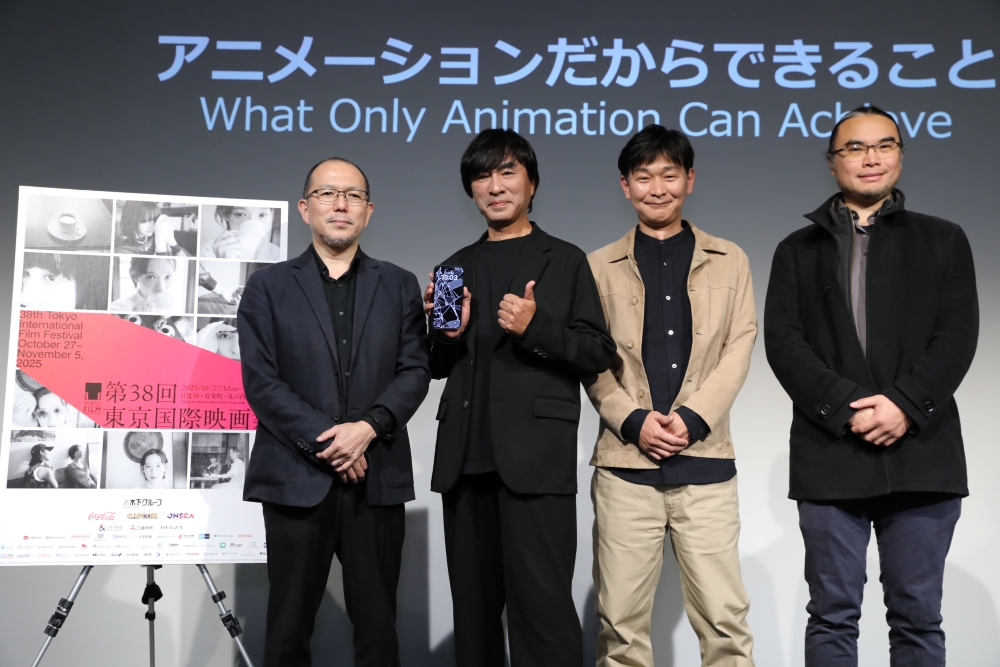
That question was mulled over of a panel including the legendary creator of Macross, Shoji Kawamori, who was showing his new original film Labyrinth in the festival’s animation strand, as well as director of The Obsessed, Takahashi Wateru, and Little Amélie or the Character of Rain co-director Liane-Cho Han (fellow director Maïlys Vallade was not present). Moderator (and programmer of the festival’s animation strand) Fujitsu Ryota contextualized the talk by mentioning that animation is made unique for the artist’s complete control over the form and structure and every aspect of how it is presented, something close to what he calls “absolute freedom.”

![Shoji Kawamori [c/o Tokyo International Film Festival 2025]](https://www.dev.animationmagazine.net/wordpress/wp-content/uploads/Dir.KawamoriShoji_-河森正治_Labyrinth.png)
But first, getting to those questions required digging down into the works of the filmmakers, and the reasoning behind the form they chose for their own features. Kawamori notes that Macross Frontier is playing on the outdoor cinema downstairs from the Tokyo Midtown Hibiya, where the event is held, before he speaks about how Labyrinth differs from that famous mecha franchise he created. It has to do with the “unreality” of social media and how we access it, primarily through the smartphone, which have in his view become symbols of our identities. That ties up with a strange overlap between our real selves and a dream self, making the internet a “world of dreams”. This is something Kawamori defines as not fantasy, but a ‘strange reality’ where the familiar is just slightly off, wanting to keep things relatively simple in service of a complicated idea.
While Kawamori’s work is concerned with the present and where that’s taking us, fellow panelist Wataru spoke about how he sought something more nostalgic and whimsical, more “animation-like” than realistic when making The Obsessed. This was in part to match the tone of the book it’s based on, but also to pay homage to the heyday of Shin-Ei Animation, where the film was produced. “I feel like nowadays we don’t have so many films that have this old-school feel to them,” Wataru says. The director, who worked on several film instalments in the Crayon Shin-chan franchise, also notes having to adapt to modern methods — the extra care taken to balance out the effects of digital coloring, which he says has a tendency to look flat if left unchecked. To a similar effect, in the design of the main setting of the film, Wataru blended architectural and geological elements from the United Kingdom and Europe. “I like visuals where you can’t really tell what country it is, so that was the basis of what we were doing,” he says, adding that they tweaked the scenery as needed to make things feel dynamic but unpredictable.
As for Han, the director of Little Amélie traces the choice for his film’s look back to work alongside co-director Vallade on Long Way North and Calamity, a Childhood of Martha Jane Cannary, two films directed by Rémi Chayé (who provided backgrounds for Little Amélie). Han speaks of enjoying the ‘lineless’ style as a sort of painterly or sculptural way of looking at animation, and how it brings up other elements. “We love when the light hits the character without any border between them,” he says, with Little Amélie continuing the visual tones of Calamity but with rounder shapes and softer colors this time, to suit the vision of an idealized and nostalgic vision of Japan to match the main child’s perspective. He also mentions the cost benefits of animating this way, saying that removing the lines saves time in the process of using cutout style animation.


Along with the attention to shape, colors and the absence of lines, Han also mentions playing with showing sensitivity through the lens, with consideration of soft focus or macro shots in the depiction of Amélie and the garden world she lords over in the film. This ties into the broader point of the session: that while animation often works with a lot of the same visual language as live-action film, the animation directors have more complete control over the flow and manipulation of that language. This ties into a later question posed to the directors about influences on their work. Citing Princess Mononoke, the work of Satoshi Kon and also a Rurouni Kenshin OVA, Han then mentions seeing a live adaptation of the former. Comparing the animated version of Rurouni Kenshin that he fell in love with and the live-action version, he said that there was a neatness to the latter that felt distancing, that it didn’t connect emotionally in the same way the animation did despite using flesh and blood actors.
The rest of the session trends towards discussion of why, exactly, that is. To the viewer it could be down to something like Scott McCloud’s description of the essential nature of illustration in the book Understanding Comics, that drawings get directly to the essence of a thing — whether a person or an object — and give it life through the author’s hand. Wataru reflects on a similar idea later in the panel, talking about creating backgrounds for The Obsessed. “When it’s rougher, it leaves a stronger impression on you,” Wataru says as he reflects on these paintings. Many of them had so many stylistic variations that they chose to lean into it, Wataru observing that even just the doors would have noticeable variations.
Kawamori’s thoughts about the differences between live action and animation express similar sentiments. Earlier, the filmmaker pondered his strong feelings towards Belladonna of Sadness, and how it achieved that with a limited number of drawings, then talking about how perhaps Japanese animation persevered through limited resources by finding beauty in the static.


Later, he says, “For me, live action is suitable for when you really want to show subtle differences in the character’s emotions, but with animation you can get more abstract.” He says that simplicity and abstractions are the medium’s great strengths. “When you go towards photorealistic style it doesn’t matter who the director is,” he responds when asked about the relationship between that idea of abstraction and the kind of 3D CG animation used in Labyrinth. To the panel, the joy of animation is in removing rather than adding. “In animation you get to cheat, you get to abbreviate,” Wataru says.
Han says that the best advice he received that he still holds close was “don’t try to impress people, try to move people.” He adds that this is because emotion is the realm of the human — technological progress, nor AI as Han mentions, can’t encroach on this. It all comes down, again, to getting closer to an essential view of how the artists see the world, the sensibilities of a group of artists coming together as a “new type of life,” as Kawamori puts it, chipping away at the real and coming to some kind of emotional truth.
The 38th Tokyo International Film Festival runs October 27 through November 7 in the Japanese capital. Learn more at 2025.tiff-jp.net.