
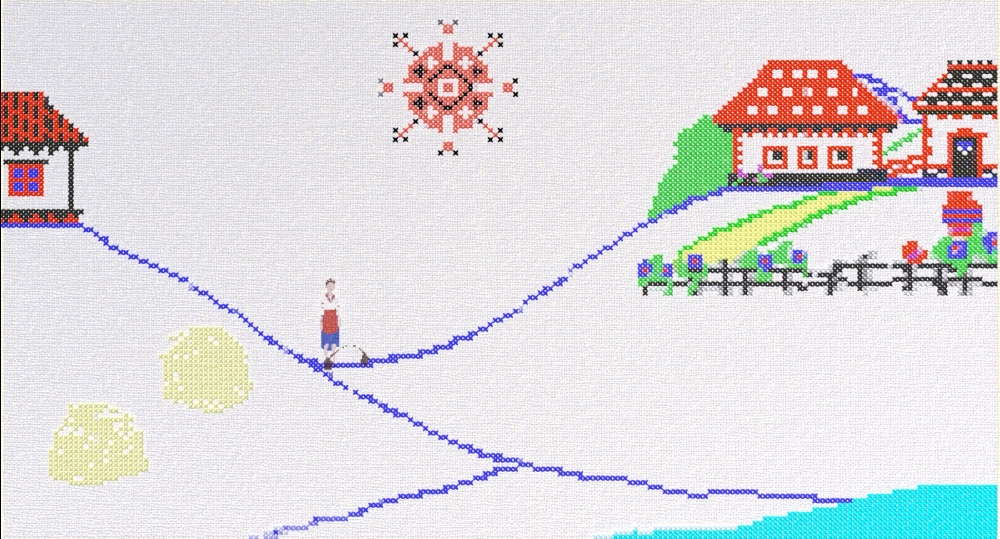

Writer-director Masha Ellsworth’s new animated short Bound (Переплетені) is one of the more striking and original shorts up for Oscar voting consideration in the animated shorts race this year. Inspired by romantic folktales of Eastern Europe, the embroidery-styled film is produced as part of the Pixar’s studio co-op program, and offers a memorable piece of Ukrainian-American representation.
Ellsworth, a lead technical director at Pixar, started out at the studio as an intern on Ratatouille in 2007, working on lighting and sets, and has since contributed to numerous Pixar feature films — including Up, Toy Story 3, Brave, Inside Out 1 & 2, Coco, Incredibles 2 and Turning Red. We had a chance to find out more about her interesting new short in our recent interview with Masha:
![Masha Ellsworth [promotional photo]](https://www.dev.animationmagazine.net/wordpress/wp-content/uploads/Masha-Ellsworth_Crossstitching-1.JPG)
Animation Magazine: Can you tell us a bit about the beginnings of the project? How did you decide to focus on this specific folk tale as the subject of your new short?
Masha Ellsworth: Bound is a project born out of both love and mystery. Growing up in Ukraine, I often heard the beloved folk song “Galya Carries Water,” and it always stayed with me, not just for its melody, but for its unanswered question: what truly happened to Ivanko and Galya? The song begins with two young villagers sharing a sweet, hopeful moment of connection and agreeing to meet again. But in the very next verse, Ivanko is suddenly angry and sad, convinced Galya stood him up, while she insists she didn’t. The story ends there, without resolution.
I was intrigued by that ambiguity and always wanted to imagine what really happened between them. Bound became my way of offering a modern interpretation of their love story: one that explores innocent misunderstandings, assumptions, and how easily we can lose someone we care about when communication fails.
The inspiration came from the folk song itself, I wanted to imagine that missing piece and give their story an ending. Visually, I reimagined their world as if it were embroidered into existence. The film looks like a traditional Ukrainian cross-stitch tapestry, inspired by the towels and textiles I grew up seeing in Ukrainian homes. To complete the atmosphere, I recorded a new version of the song using bandura and sopilka, traditional Ukrainian instruments whose sounds carry both nostalgia and warmth.
When did you begin work on it and how long did it take to make?
I first wrote the treatment for Bound about seven years ago, but the project sat quietly, waiting for its moment. When the war in Ukraine began in 2022, I felt an urgency to bring it to life. That’s when I reached out to my dad, who was living in Ukraine at the time, and asked him to collaborate with me on the film. From that point, production took about eight months, a deeply personal process that became both a creative journey and a way to stay connected to home during an incredibly difficult time.

Which animation tools were used to create it?
Bound was created using a combination of traditional 3D animation tools. Modeling and rigging were done in Autodesk Maya and Mari, while Houdini was used to generate the intricate cross-stitching effect that gives the film its signature embroidered look. The project was rendered in RenderMan and composited in Nuke, bringing together all the layers of texture and light that make the world feel handcrafted.
How many people worked on it with you?
It was a very small, close-knit production team, mostly just me and my father, Mykola Martynenko, a Ukrainian architect who designed the sets for the film. I also had two wonderful collaborators who helped with compositing, title design, and the stop-motion end credits. The largest part of the team came together during post-production, led by my composer Rebecca Nisco and post-production supervisor Cassandra Rodriguez. They worked their magic to find and record Ukrainian vocalists and musicians who could perform with traditional instruments like the bandura and sopilka, giving the film its authentic sound and emotional depth.
Who are your big animation heroes?
I grew up watching the Ukrainian animated series Cossacks by Volodymyr Dakhno, which had a huge influence on me. His work celebrated Ukrainian identity through humor, music and timeless storytelling. It showed me that animation could be both deeply cultural and universally relatable. I was also inspired by French animation, especially Asterix in Britain directed by Pino Van Lamsweerde, and of course by Tom and Jerry shorts, which amazed me, proving that great animation truly speaks to everyone.

What do you love about working on your own personal animated shorts?
I love the creative freedom that comes with making personal animated shorts, the chance to explore ideas that feel deeply personal, experiment with new tools, and take creative risks. Working independently allows me to follow my curiosity wherever it leads, while still drawing on everything I’ve learned from the collaborative, structured environment of studio filmmaking. It’s a space where I can reconnect with the pure joy of storytelling and rediscover why I fell in love with animation in the first place.
What was your biggest challenge along the way?
I’d say one of the biggest challenges was adapting to how audiences consume animation today. It’s no longer just about making a film: it’s about understanding how to present it so it can truly reach people. Learning how to package and share the work across different platforms, from festivals to vertical streaming and social media, has been a creative challenge of its own. It’s pushed me to think not only as a filmmaker but also as a storyteller who meets the audience where they are.

What are you working on next?
I’m currently bringing my next animated short, Wishing Trees, into the festival circuit. It’s a poetic story about what happens when a wish placed on a tree doesn’t come true — a reflection on the conditional love of humans versus the unconditional love and wisdom of nature.
At the same time, I’ve begun production on an animated mini-series that explores Ukrainian folklore and cultural traditions, expanding on the world and spirit that inspired Bound. Both projects continue my passion for telling human stories that transcend cultural differences, stories that connect us through shared emotion, empathy and imagination.
What kind of advice would you offer animation newbies who want to make their own shorts?
My advice would be to find people who share your passion for filmmaking: collaborators, friends or mentors who understand the challenges of creating independently. Making an animated short can be tough, and it’s easy to feel isolated along the way. Having a small circle of people who can encourage, inspire, and listen makes all the difference. Surround yourself with those who remind you why you started and who help you keep going when things get difficult.
Bound is available to Oscars voters in the Academy Awards Screening Room. Preliminary voting will be conducted from December 8-12.