


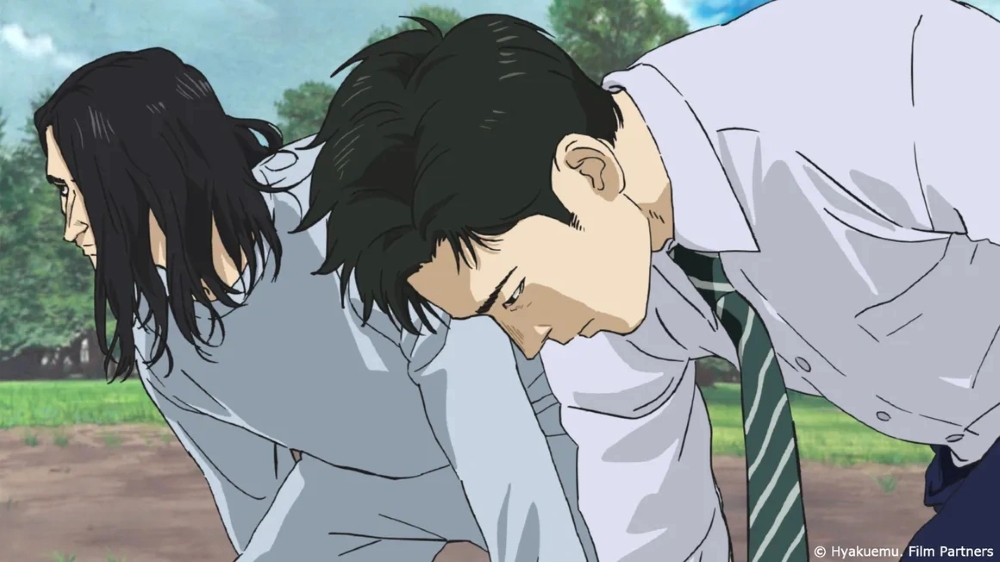


“There were almost no film works in Japan themed around the 100-meter dash, a short-distance event, so the idea of taking on something no one had attempted before felt incredibly appealing.”
— Director Kenji Iwaisawa
In 2019, Kenji Iwaisawa released his outrageous On-Gaku: Our Sound, a highly personal, low-budget feature about three unprepossessing high school students who form a band — even though they have no training, no talent and no knowledge of music. Adapted from Hiroyuki Ohashi’s self-published manga, On-Gaku: Our Sound had a subversive punk energy that set it apart from more elaborate conventional features.
Iwaisawa’s new film, 100 Meters (Hyakuemu), is based on a manga by Uoto that follows two talented sprinters from elementary school through high school to the pro track circuit as adults. Togashi is so naturally gifted, he remains undefeated in the 100-meter dash, but he runs like a machine on autopilot. His victories bring him little pleasure. Komiya started running to escape his inability to relate to other people, but he’s had no training — he runs in shoes that are falling apart out of loyalty to them. Togashi coaches Komiya; Komiya helps Togashi discover the excitement of running. A long-term friendship and rivalry develop, culminating in a final high-stakes race.

Dynamic Dash
100 Meters is a much more polished film than On-Gaku: Our Sound. Iwaisawa, who says he had “absolutely no running experience,” skillfully blends rotoscoping with drawn animation to capture the energy of the sport. He talked about 100 Meters in a recent email interview with Animation Magazine.
“There were almost no film works in Japan themed around the 100-meter dash, a short-distance event,” says Iwaisawa. “So the idea of taking on something no one had attempted before felt incredibly appealing. The original manga was quite substantial, so we had to discuss how to adapt it to fit the film’s running time, which inevitably required restructuring the narrative. I initially proposed, ‘I’d like to go with this structure, including some original film elements.’ We then had several rounds of feedback from Mr. Uoto.”

The look and tone of 100 Meters is very different from On-Gaku: Our Sound. “100 Meters is a sports story, featuring Togashi, a genius, and Komiya, who lacks talent but runs with a possessed, relentless drive,” says the director. “It’s also about two completely different types [of people] meeting and eventually forming a rivalry where their positions reverse. Naturally, this led to a slightly more stoic narrative than On-Gaku.”
Iwaisawa watched runners on YouTube and even tried frame-by-frame analysis of the motions, but because he’s not an animator himself, he says he left the movement and running sequences to Keisuke Kojima (One Punch Man, Hunter X Hunter: The Last Mission), who handled the character design and animation direction. “While I personally didn’t research it that deeply, the team naturally did extensive research and translated the movements into animation,” he adds. “I used rotoscoping because I can only create using that method.”

The director mentions that expressing the sense of speed was difficult. “In regular animation, running is depicted using three-frame or two-frame poses, but running at incredible speeds like an athlete does is quite rare in standard animation,” he explains. “I realized a full-out sprint moves in single frames, not three frames or two frames. When you see actual athletes running, they’re so fast it gives you the illusion they might be fast-forwarded. That’s how different an athlete’s run is from an ordinary person’s run.”
One of the film’s challenges was staying consistent as it takes the two main characters from boyhood to adulthood. “The elementary school part and the high school part were made by different teams,” he explains. “The elementary school part was made using a method closer to standard animation techniques, while the high school part used rotoscoping. We had the difficulty of different teams using different methods. The characters sometimes moved in ways we hadn’t intended, or elements added with good intentions ended up completely opposite to our vision. Adjusting for that was a real challenge.”

Tracking the Story
Another challenge was how to show two stoic characters like Togashi and Komiya communicate their feelings visually. “Togashi had expressive facial expressions, so conveying his emotions wasn’t too difficult,” recalls Iwaisawa. “But with Komiya, it’s more about suppressing his feelings — there are times when you genuinely can’t tell what he’s thinking. Animation often uses facial expressions to convey emotions, but Komiya is a character who struggles with that, so that part was challenging.”
The film also uses training montages as a way of communicating a lot of information without any dialog. “As the director, it was difficult to pace them so they don’t become too choppy,” he points out. “We shot the live-action footage first and edited it and established the pacing. With regular animation, I think you’d adjust the pacing during the storyboard stage or once the drawings are in, but with rotoscoping, you can establish a certain rhythm with the live-action footage first, so it wasn’t that difficult.”
 100 Meters’ final race takes place during a rain, which reduces the colors to black, gray and white. “When I started this project, the first thing I did was go to a track meet,” says Iwaisawa. “I witnessed a sequence you can only see at the venue: The athletes entering before the race, setting their starting blocks and warming up. Seeing that routine made me think, ‘I want to include this scene in the movie.’ I thought that if we could show it in one continuous take, following the athletes the whole time, it would make for a truly cinematic highlight. I wanted to express that part with a lavish, bold approach. The rain depiction wasn’t particularly difficult, as the original manga features a rain-soaked final race. To convey that, we used techniques like muting the colors: I believe it became one of the most memorable scenes in the film.”
GKIDS released 100 Meters in select theaters in the U.S. in October following its Japan premiere in September and international debut at Annecy. The film is produced by Rock ‘n’ Roll Mountain, Pony Canyon, Asmik Ace and Tokyo Broadcasting System.