




“A man walks into a bar…” This classic line might be the setup for one of the oldest jokes in the world, but this year it also provided a hook for Student Academy Award-winning film The 12 Inch Pianist. Animator Lucas Ansel, who directed the stop-motion project while attending the Rhode Island School of Design, recalls bouncing around ideas for his film when someone suggested he consider “guy walks into a bar” jokes. “I felt like an idiot for not having thought of that sooner,” Ansel admits. “That’s how I discovered Simon Rich’s brilliant short story in The New Yorker, and he generously let me base my screenplay on it.”
The New York-based Ansel felt right at home when he collected his medal for his popular short, as this year’s Student Academy Awards were presented on October 6 at the Ziegfeld Ballroom during the New York Film Festival. His fellow medalists had a longer road to travel: The winners from the Gobelins Master’s Program in Character Animation and Animated Filmmaking — led by Sofiia Chuikovska, Loïck du Plessis d’Argentré and Maud Le Bras — traveled from France to receive their prize for The Shyness of Trees. And winner Tobias Eckerlin, from the Filmakademie Baden-Württemberg’s Animationinstitut, came all the way from Germany to accept his medal for A Sparrow’s Song.
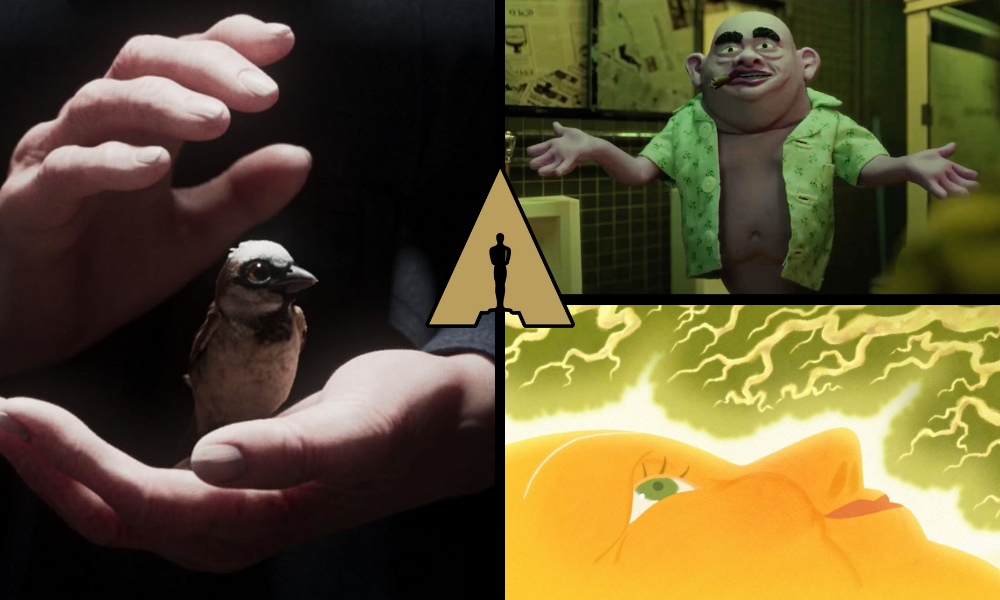
This year’s three prizewinning films (now in the running for the 98th Oscars) couldn’t be more different — and not just because of their diverse countries of origin. These student animators have all created unexpected characters who inhabit distinctive worlds. The 12 Inch Pianist takes viewers into a gritty dive bar where its stop-motion protagonist comes face to face with surreal characters confronting queer identities. By contrast, The Shyness of Trees explores the relationship between a dying woman and her adult daughter, and blends sweeping visions of botanical imagery with poignant dialog. Life-and-death issues also lie at the heart of A Sparrow’s Song, which uses CG stylized realism to breathe life into a WWII-era underground bunker, depicting how living beings survive against war’s extreme odds.
![A Sparrow's Song [Filmakademie Baden-Württemberg]](https://www.dev.animationmagazine.net/wordpress/wp-content/uploads/Sparrows-Song-1.jpg)
Gold Medal: A Sparrow’s Song
Directed by Tobias Eckerlin
Filmakademie Baden-Württemberg (Germany)
![Tobias Eckerlin [provided by subject]](https://www.dev.animationmagazine.net/wordpress/wp-content/uploads/Tobias-Eckerlin.jpg)
From 2022 to 2025, a core group of artists from the Filmakademie Baden-Württemberg joined director Tobias Eckerlin to realize his vision for a computer-animated wartime tale, A Sparrow’s Song. Eckerlin, who earned his directing diploma from the school’s Animationsinstitut, credits the contributions of 56 people in helping realize his vision for the film.
To direct such a large team, Eckerlin used the key tools of PureRef, Autodesk Flow and SyncSketch. “We had an animatic, a project bible, an animation bible and a style guide.”
The dark, emotional story centers on an elderly WWII widow who nurses an injured sparrow back to life while escaping repeated bombings in an underground bunker. The film’s stylized realism, with its chiaroscuro lighting, captures the subtle ways in which human kindness can survive the inhumanities of war. The gentle touch of the widow’s hands cradling the injured bird provide the film’s tender signature image.
“Hands are such an important part of human communication,” notes Eckerlin. “In connection with the sparrow’s small size, the idea emerged to convey the characters’ emotions through their hands. Our animators brought the hands to life in such a detailed and beautiful way.”
(A fitting coincidence is that the Animationsinstitut is now headed by former Pixar director Jan Pinkava, whose Oscar-winning 1997 short Geri’s Game was heralded for its expressive depiction of human hands.)
![The 12 Inch Pianist [Rhode Island School of Design]](https://www.dev.animationmagazine.net/wordpress/wp-content/uploads/12-Inch-Pianist-2.jpg)
Silver Medal: The 12 Inch Pianist
Directed by Lucas Ansel
Rhode Island School of Design (U.S.)
![Lucas Ansel [provided by subject]](https://www.dev.animationmagazine.net/wordpress/wp-content/uploads/Lucas-Ansel.png)
The clearest path to a finished production isn’t always evident for student animators, especially given the diversity of tools available today. Rhode Island School of Design graduate Lucas Ansel candidly recalls, “I came into senior year still having no clue what to make, and there was a fair amount of pressure from my teachers to just start. I didn’t want to move forward without a strong story, so in a very untraditional way (for animation), I just started building a set. Since the style I’ve developed uses stop-motion characters composited into Blender 3D digital environments, I had the freedom to build without worrying about taking sets apart or fitting a huge camera into them.
“I started with a grungy dive-bar bathroom,” he explains. “They’re interesting spaces to me, full of texture and hidden stories. When the story still hadn’t come to me, I built out the rest of the bar set, killing time [by] filling it with as many intricate details as I could.” Once Ansel discovered Simon Rich’s New Yorker story, his team of classmates and friends fell into place. Everyone had some filmmaking experience, but not all had done stop motion before. Ansel’s mom even made the puppets.
Ansel says the 7.5-minute-long The 12 Inch Pianist exhausted his entire tool kit. “The film features clay puppets with hand-tailored clothes animated on greenscreen and composited into Blender environments,” he recalls. “Along with keying and compositing every shot in After Effects, I also animated the characters’ pupils and mouths in post with custom Photoshopped assets for every shot to match the on-set lighting. Finally, I photo-scanned all my puppets, using them as digi-double stand-ins for lighting and compositing references.”
Ansel might have gotten a slow start on his short, but after a year and a half in production, he had completed a winning film.
![The Shyness of Trees [Gobelins]](https://www.dev.animationmagazine.net/wordpress/wp-content/uploads/SHYNESS_OF_TREES_4.png)
Bronze Medal: The Shyness of Trees
Directed by Sofiia Chuikovska, Loïck du Plessis d’Argentré and Maud Le Bras
Gobelins (France)
![The Shyness of Trees film team [provided by subjects]](https://www.dev.animationmagazine.net/wordpress/wp-content/uploads/SHYNESS_OF_TREES_team.jpg)
“A little bit of everything” was the phrase that the students from Gobelins use to describe their winning film, The Shyness of Trees. The nine-minute piece follows a woman’s visit to her elderly mother in the countryside, where she witnesses an uncanny affinity between her aging parent and a mighty, mysterious oak tree.
The Paris-based trio of Sofiia Chuikovska, Loïck du Plessis d’Argentré and Maud Le Bras headed up the yearlong production, working from Loïck’s original script. As he explains, “During preproduction, a lot of drawings were made traditionally with pen and paper, and some animation tests were made with different mediums like gouache, aquarelle and pastels. Then during production, it was almost all digital — animating in TVPaint and using 3ds for some set designs or as a reference for the character models. We also used compositing tricks in After Effects to mimic digitally some of the traditional texture tests, in order to save some time.”
The Shyness of Trees has the quality of a dream, as the younger woman struggles to make sense of her mother’s world. Fellow students Lina Han, Simin He, Jiaxin Huang and Bingqing Shu each contributed little parts of their own relationships with their parents to the story, which informed the final narrative. Sofiia Chuikovska, who directed the production, notes, “Some people were very specialized and focused on polishing specific aspects of the film, while others were very polyvalent and carried the workload doing a little bit of everything.”
Given how deeply collaborative this production turned out to be, it is fitting that the whole team attended the awards ceremony in New York City. As Chuikovska notes, “It will be the first time since the end of school that we’re all reunited.”
Considering that this year’s competition received 3,127 entries from 988 colleges and universities worldwide, it seems like the perfect reunion.