

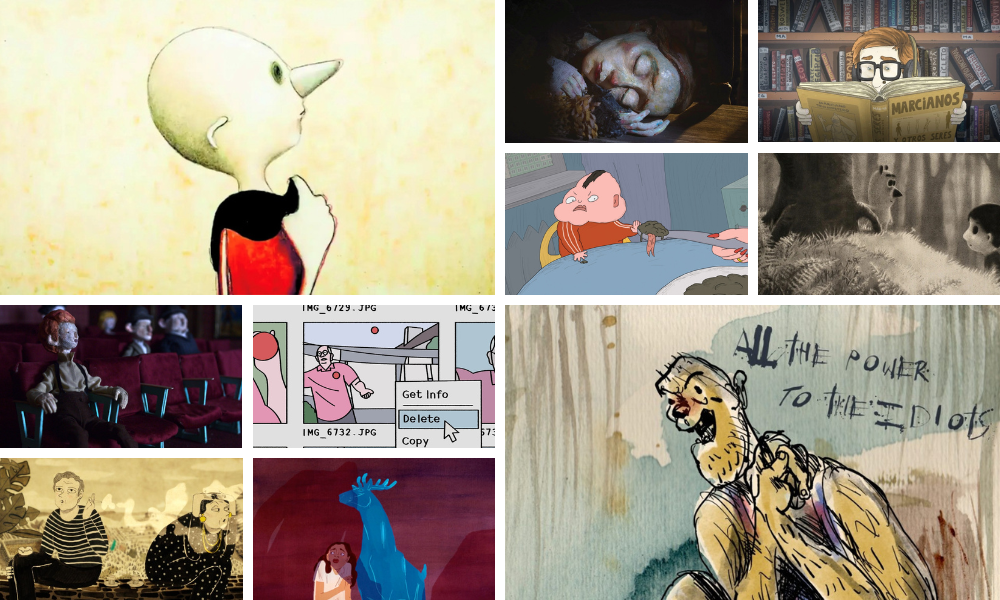


From the festival circuit, this looks like a wide-open year for shorts chasing the statuette named after Steve Austin’s (a.k.a. The Six Million Dollar Man) boss. Audience favorites are scattered, and festival wins rarely predict academy taste. So here’s a two-lane list: films I love that probably won’t meet Oscar Goldman and titles I didn’t go lady (or, if you prefer, radio) gaga over but that are carrying real festival buzz. I won’t tell you which is which though!
Dog Alone
Director: Marta Reis Andrade | Country: Portugal
A documentary-adjacent short with an earthy palette punctuated by sharp accents, Dog Alone follows a troubled young woman who escapes the alienating city for her recently widowed grandfather’s rural home. There she drifts through neighbors, family, the countryside — and an abandoned dog — each encounter echoing her own isolation. What begins in disconnection resolves into a quiet study of care: generations knitting together, a community reappearing at the edges and a life retuned by shaking off the world’s noise to find balance, calm and purpose.
The Girl Who Cried Pearls
Chris Lavis and Maciek Szczerbowski | Canada
From the Oscar-nominated makers of Madame Tutli-Putli, Clyde Henry (Chris Lavis & Maciek Szczerbowski) returns with a retro-glossed stop-motion fable about stories — the seductive myths we sell to others and ourselves. On his 80th birthday, a wealthy grandfather catches his granddaughter pocketing a rare pearl and, to explain its origin, rewinds to a childhood meeting with a girl whose tears turned to jewels. Miniature worlds — from a faded Parisian villa to a 1910 Montreal tenement — are rendered with tactile textures, lifelike puppets and gliding camera moves, while Patrick Watson’s haunting score threads through greed, loss and the fragile magic of small wonders.
Dollhouse Elephant
Jenny Jokela | Finland
After the scalpel-sharp Sweet Like Lemons (2023), Jokela is back with Dollhouse Elephant, an acrylic-on-paper dazzler. A layered choral score sets the thesis: One off-key voice can splinter the whole. Brushstrokes bend and buckle with each crescendo, staging the tug-of-war between communal harmony and individual drive. In brisk, painterly set pieces, the film asks whether solidarity can hold in a world tuned to the solo — without muting the soloist.
Life With an Idiot
Theodore Ushev | France
After a brief live-action detour, Ushev returns to animation with a Kafka-tinged tragicomedy, co-adapted with his daughter Alexandra from a book by Victor Erofeyev. Dominique Pinon voices Vladimir, a twice-widowed everyman hauled before faceless authorities and ordered to atone for his unremarkable life by housing an “idiot” — a mandate that quickly curdles into farce. Set to a skirling operatic vocal, the film’s fluid watercolor on paper and jittery, hand-painted frames — evoking Koji Yamamura’s A Country Doctor — splinter as Vladimir’s reality does. A whirlwind of collapsing borders and restless color, it’s among Ushev’s most unsettling work, prodding a spectacle-numb world with a final barb: Who’s the idiot, exactly?
Shadows
Rand Beiruty | France, Jordan
Amid the churn of an airport, 15-year-old Ahlam watches the crowd until a stray deer slips past — an uncanny spark that unlocks a rush of memory. The film toggles between her hushed inner monologue and the prying looks around her as she recalls a marriage at 13 to an abusive, unstable husband, a birth at 14 and a child taken soon after. Now, fleeing Baghdad, she moves toward the gate with those shadows still attached. Lush, painterly backdrops belie how raw this is. Drawn from interviews with Ahlam, Shadows uses expressive shifts in perspective to make her past feel immediate — and to ask whether crossing a border can ever outpace the pain that follows.
Il Burattino e la Balena
[The Puppet and the Whale]
Roberto Catani | Italy
Catani — of La Sagra and La Funabola — returns with a hand-drawn fable, Il Burattino e la Balena. Pinocchio splinters into life: a testy toe-tap, then a cap that turns play into threat. He climbs a narrow stair to a procession moving with machine precision, as if all carved from the same plank. Catani’s stark line collapses puppet and person, asking what choice survives when every step feels pulled by unseen strings.
Kyiv Cake
Mykyta Lyskov | Ukraine, Estonia
From the creator of the cult short Deep Love (2019), Kyiv Cake is a bracing, surreal tour of Ukrainian life under pressure. It opens on a trotting, crooning deer to a Eurodance thump, then narrows to a struggling family: a husband wrestling the electricity meter; toothpaste bleeding the Russian tricolor as a tooth drops; a near-empty fridge holding a Kyiv Cake box that hides a Ukrainian passport. The husband sprouts wings, a missile rips the building, and the son fires back with the Snake Island defiance: “Russian warship, go fuck yourself!”
Working with an Estonian studio, Lyskov channels a tradition of Baltic absurdism — stacked symbols, mordant humor, dream logic — to smuggle hard truths past the rational mind. Raw, anxious and angry, Kyiv Cake refuses despair, searching for something possible inside the impossible — something bearable carved from the unbearable.
Silent Cinema
Krste Gospodinovski | North Macedonia
A man remembers threading reels with his father — a faded silent film star turned projectionist — in a crumbling movie house devoted to silents. In the theater’s underbelly he discovers a secret: his father quietly screening sound films, a forbidden world the boy never knew existed and the father hopes to keep hidden.
This stop-motion puppet elegy to early cinema — and to its many fallen stars — is also a tender father-son portrait. Its hand-built aesthetic becomes a love letter to the communal spell of moviegoing, now dimmed as viewing shifts from public rooms to private screens. Without scolding, the film questions our appetite for “progress” — the restless chase for new tools and sensations — and suggests that the promise of tomorrow too easily eclipses the grace of the present.
Poor Marciano
Alex Rey | Spain
Rey’s Poor Marciano is a deadpan comedy about inherited obsession and shame. Marciano grows up under Paco, a father whose devotion to the band Crash Test Dummies amounts to zealotry; when the kid sneaks Tears for Fears, he’s sent to bed hungry. The joke stays ruthlessly focused as Marciano retreats into science, becomes a reclusive astrophysicist and develops a furtive, compulsive private life.
Rey keeps the tone straight-faced and the rhythm precise, letting a single ridiculous fixation snowball until Marciano is tasked with sending Earth’s first official message to Martians — and fumbles it spectacularly. What starts as a one-note gag turns unexpectedly sharp: a portrait of how pop culture burrows into us, warps our desires and dictates our scripts. It’s brisk, a little cruel, oddly tender — and as stubbornly catchy as the song that haunts it.
Retirement Plan
John Kelly | Ireland
John Kelly’s Retirement Plan strips away ornament to let timing and voice do the work. Over stark, minimalist visuals, Domhnall Gleeson inhabits a man cataloging everything he’ll do after he retires; as the list swells, confidence curdles into denial. The humor lands with a slow ache, and the restraint sharpens the film’s point: Self-delusion is funnier — and sadder — when there’s nowhere to hide.
(Watch the full short here.)
The Night Boots
Pierre-Luc Granjon | France
On his way to bed — while his parents bustle to host visiting friends — Elliot slips on his rubber boots and wanders into the dark, where a curious beast ushers him through the forest’s nocturnal life — a tribute to the weird, luminous charge of childhood curiosity. Rendered in a misty pinscreen that recalls Tarkovsky’s The Mirror and Norstein’s Tale of Tales, the film’s fog-softened textures lend Elliot’s night wanderings a dreamy, poetic hush — retro animation catnip. The Night Boots pulled off the rare Annecy double this year, winning both the Cristal for Best Animated Short and the Audience Prize.
![Chris Robinson [provided by subject]](https://www.dev.animationmagazine.net/wordpress/wp-content/uploads/Chris-Robinson-1.jpg)
Chris Robinson has been the artistic director of the Ottawa International Animation Festival (OIAF) for the past 25 years and has authored numerous books on independent animation, including Stole This From a Hockey Card, Canadian Animation, Ballad of a Thin Man and Raw Outrage: The Films of Phil Mulloy. He also wrote the screenplay for the award-winning animated short film Lipsett Diaries.