


Wild Child Animation is pulling back the curtain on the technical and creative innovations behind Piripenguins, the new children’s comedy created by series director Massimo Fenati (Quentin Blake’s Box of Treasures). Produced by Eaglet Films together with Red Monk Studio (Italy) and in partnership with Wild Child Animation, the show has been commissioned by BBC and RAI, alongside support from the UK Global Screen Fund — financed by the UK Government’s Department for Culture, Media and Sport and administered by the BFI.
Piripenguins (52 x 11′) premiered on CBeebies in May 2025 and is now being distributed internationally by Banijay Kids & Family and PBS Distribution (North America).
The show may look deceptively simple on screen, but achieving its distinctive style required bold creative and technical choices. The Wild Child team pushed Unreal Engine into uncharted realms, bending real-time technology to create a uniquely stylized show.

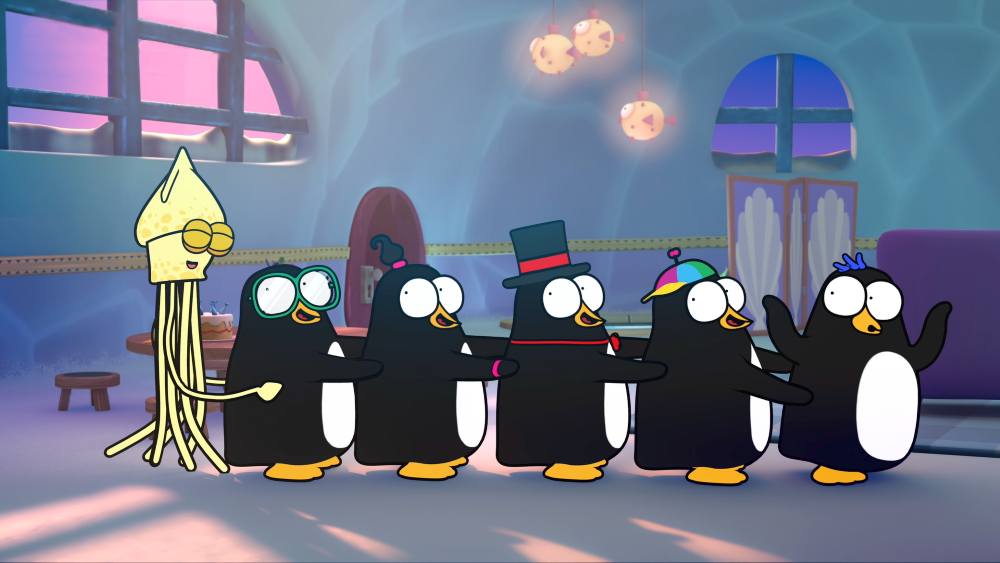
“I created the characters a few years ago as 2D,” Fenati explained, “and I wanted to preserve the same streamlined design for its immediacy, but I feared that a 2D environment made of mostly ice and water could be too flat and repetitive, so I always thought that the characters should inhabit a 3D world with all its potential for texture, lighting nuances and a richer, more involving environment. So my vision for the show was to create a 2D/3D hybrid and Wild Child responded with enthusiasm to the brief and delivered a perfect match to what I had in mind.”
The challenge was clear from the beginning: translating the 2D illustrated charm of Fenati’s original designs into a fully realized on-screen series. Traditional compositing or layering 2D elements over static backgrounds would have undermined the potential of Unreal’s real-time lighting and dynamic camera tools, whereas a fully 3D character solution would have compromised the visual charm of the show.
Wild Child’s solution was a hybrid one, combining their 2D and 3D animation capabilities within a custom Unreal pipeline. The team used 3D environments and character bodies paired with 2D facial rigs, which gave the team full control over physical interaction with the sets. Characters could sit on furniture, pick up props and cast shadows, while still holding onto the illustrated aesthetic that defined the original design.

“Preserving the integrity of the designs on Piripenguins while making it work technically meant constantly striking a balance,” said Will Adams, episodic director. “Every choice had to serve the illustrated aesthetic, the different teams in the pipeline had to work closely to make it all feel seamless across shots. What could have been a technical compromise became a deliberate visual signature, and added to Piripenguins’ distinctive style.”
This approach also reshaped the animation process itself. Animators had to abandon standard 3D workflow assumptions and embrace a 2D mindset. It wasn’t about making the rigs behave, it was about making them feel illustrated, with every frame on model and every movement grounded in graphic intent. With nearly identical main characters, personality had to come partly from how the characters moved: a head tilt, a pause, a shuffle. Small gestures carried the weight of performance. Constraints sharpened the work and helped shape the style.
The Unreal Engine pipeline used on Piripenguins leveraged the studio’s extensive experience in both 2D and 3D to build a robust, scalable real-time workflow, adaptable to the demands of the show’s unique style. The team also implemented USD to keep assets consistent across Maya and Unreal, eliminating continuity issues between departments and international partners.

“While Unreal wouldn’t normally be the first choice for a show like this, we had been talking about doing a stylized 2.5D show for sometime and now we had the opportunity,” says Ron Henry, Chief Operations Officer at Wild Child. “We also weren’t starting from scratch. We had a proven Unreal pipeline, the right tools, and the 2D experience to pull together something unique. That gave us the confidence to support a highly stylized 2D/3D hybrid, at scale, without slowing down.”
Unreal’s real-time rendering wasn’t just about speed; it gave the creative team the flexibility to explore, iterate, and further develop the visual style. That immediacy helped define the show’s look and made the hybrid 2D/3D approach viable across 52 episodes.
Learn more about the studio’s Piripenguins process in their behind-the-scenes video on wildchildanimation.com.