Tag: featured

  • Dutch Dynamos: Amsterdam’s Submarine Celebrates 20 Years of Innovation

    Dutch Dynamos: Amsterdam’s Submarine Celebrates 20 Years of Innovation

    ***This article originally ran in the February ‘20 issue of Animation Magazine (No. 297)***

    This month, Amsterdam-based animation studio Submarine is celebrating its 20th anniversary of its launch. Since its inception, the studio has been on the forefront of mixing different animation styles and producing content for a wide variety of audiences around the world. This past year, the studio was a key player in producing the animation for Amazon’s acclaimed new series Undone and the European Animation Award-winning feature Buñuel in the Labyrinth of the Turtles. We caught up with the studio’s co-founders Femke Wolting and Bruno Felix to find out what’s on tap for the innovative shop in 2020 and beyond:

    Bruno Felix and Femke Wolting
    Bruno Felix and Femke Wolting

    Can you tell us a little bit about the history of the studio?

    From inception, Submarine has been a hybrid company mixing disciplines – blurring the lines between documentary, animation and interactive projects. In the early 2000s, we made an animated documentary about the history of sneakers as cultural icons, using animation mixed with archive footage, which is an early example of how we work blending these tools. Some of our other initial projects include an interactive motion comic adaptation of The Killer by Matz and artist Luc Jacamon, before we moved into linear animation with children’s series Kika & Bob. The studio really was born out of us applying animation to documentary and interactive projects and it grew from there.

    Can you talk about your principle of breaking the boundaries of what animation can and cannot do?

    Starting the company – Bruno and I loved design and graphic novels and wanted to use animation outside the confines of children’s programming and cartoons as a tool for storytelling. We also launched a website called “Forget the Film, Watch the Titles” – because of our love of title design and animation. That also speaks to our interests in the intersection of film, animation and graphic design, which has driven our creative work from the start. We grew up at a time where production tools became digital, so it was a burgeoning of possibilities – all these genres that were quite separate now became easier to combine. Exploring the new language of visual storytelling that this gave rise to is really why we started the studio. From the start we had the ambition to work for a worldwide audience. We produced many children’s series in co-production with broadcasters around Europe, and our work with the global streamers began in 2016 when we produced Mattel’s Wellie Wishers series for young audiences on Amazon Prime.

    You seem to have quite an eclectic slate of interesting, original animated projects on your current slate. Can you tell us what makes an ideal Submarine project?

    We love interesting stories: We like to be innovative in our visual storytelling and mainly focus on contemporary tales with resonance in the world today. We want to tell stories about the times we live in, in visually striking ways – The Last Hijack was a film about Somali pirates which explores themes around globalisation and crime but in a really imaginative way – similarly with Undone we are pushing the boundaries of a traditional scripted series.

    The Last Hijack
    The Last Hijack

    How many are employed at the company, and what are some of the animation tools you use in your projects?

    We’re one of the biggest independent companies in the Netherlands, we have a permanent staff of about 25 people but that fluctuates with productions — it peaks around 100 people depending on the project. We do 2D, 3D, rotoscope, stop-motion — we’re a multi-disciplinary studio.

    Can you tell us a little bit about your upcoming projects?

    We’re working with the incredible Ari Folman on Where Is Anne Frank, which looks at a familiar story but in a totally fresh and powerful way, with the emphasis on making it accessible and meaningful to young audiences. We’re developing a rotoscope sci-fi YA animated series, for a generation of teenagers who have grown up with animation as an integral part of telling sophisticated stories. We’re also starting work on the second season of Undone season 2 for Amazon Prime, and a mixed media feature-length reimagining of Coppelia shot with the Dutch National Ballet which will feature live-action dancers in an animated environment.

    Where is Anne Frank
    Where is Anne Frank

    Undone has really made a big impression on fans all over the world. How did that project come about?

    We were approached by Tornante, which also produces BoJack Horseman, because the showrunners Kate Purdy and Raphael Bob-Waksberg had developed the scripts for Undone. They loved the work of director Hisko Hulsing, who was the production designer we worked with on The Last Hijack. Tommy Pallotta, co-director of The Last Hijack and a frequent Submarine collaborator also produced A Scanner Darkly and Waking Life and had pioneered a technique of rotoscoping for those films – which Tornante and the creators were keen to use for this series.

    What do you look for in animation partners around the world?

    We have predominantly co-produced which has seen us working with a wide network of European and international partners. For example we are now celebrating a successful collaboration for the animated feature film Buñuel in the Labyrinth of the Turtles that we produced together with Spanish producer Manuel Cristóbal, which just won the European Film Award. We are always looking for partnerships where we can collaborate to use animation innovatively, with people who have ideas that excite us. Animation really lends itself to a global audience so we are also keen to develop projects internationally that can reach a broad spectrum of viewers — which is more and more possible because of streamers.

    Buñuel in the Labyrinth of the Turtles
    Buñuel in the Labyrinth of the Turtles

    What is your take on the state of animation worldwide?

    It’s a very exciting time to be working in animation as it’s become more accepted as a mainstream form of storytelling and it’s used in so many different kinds of projects. There’s an enormous freedom and potential to make work in this medium.

    What is the biggest challenge facing an innovative animation studio in Amsterdam?

    We have to be strategic in our partnerships because we rely on coproduction to finance projects fully – the Netherlands is a relatively small country, which is why we opened a U.S. office to give us more options for our work. The challenge is balancing the reality of multiple partners and still maintaining an overall creative vision for a piece of work. Having a presence in the U.S. has been instrumental in allowing us to develop more productions for the global streamers.

    Do you get any support from the Dutch government?

    Yes, there is a 30% Dutch tax rebate – which allowed us to finance a substantial part of the budget for Undone out of the Netherlands.

    Undone
    Undone

    Can you share some of Submarine’s interesting plans for 2020 and beyond?

    We will be working on Undone season two and focusing on growing our slate with original projects across features, television series and short-form interactive content. We are also starting production on the feature film Fox & Hare based on the TV series we just launched, and we are developing the preschool series Pol the Pirate Mouse with Gaumont.

    You can find out more about the studio at submarine.nl.

    Pol the Pirate Mouse
    Pol the Pirate Mouse
  • Go Behind the Scenes of ‘Klaus’ with Annie-Nominated Animator Sergio Martins

    Supervising animator Sergio Martins is up for an Annie this year for his work on the acclaimed 2D-animated feature Klaus. The Lisbon-born artist says the first time he saw the proof of concept trailer for the movie, he was really impressed because it actually surprised him. “I was really curious,” he recalls. “How did they do it? What’s the secret behind it? This kind of feeling happened when I was a kid watching animation, but it went away, and this trailer kind of brought it back again. In a sense, it was this feeling of a moving illustration that really made me fall in love with the technique.”

    Martins says there is a big difference in working on a 2D animated feature versus a purely CG one. “When you draw something, you actually are putting way more artistic choices in every single graphic choice you do,” he explains. “In 2D animation you have wide open space, and there’s nothing there, and you need to just makes something. Every expression is unique because it’s not the 3D rig that someone moved. It’s a drawing that an artist did from the very beginning.”

    The animator points out he really wanted to find out about the history of Alva, who is the schoolteacher that the film’s main character falls for.

    “Alva was designed first by our character designer Torsten Schrank. He created one drawing that our director Sergio Pablos liked. And then Sergio asked me to draw some expressions around it and explore the character further and bring more richness to it. I had a bit of trouble finding who she was, because it was a bit of a flat character, like she was angry and mad at the world,” Martins explains.

    “Then one day, I had this little idea: Who was she before? I went to search. Who is this character before this movie started? And I imagined she was probably from a wealthy family, compared to the other villagers at least. So she is this rich woman, and then she finds herself in the middle of a fish market in this village. What was interesting that we got to explore the contrast between someone who was very delicate before her current life: So I kept those gestures even when she’s mad because she’s selling fish. There’s also an extra layer of sarcasm because she’s a bit bitter. Suddenly, I had all these layers to work with that it was almost automatic.”

    Klaus
    Klaus is up for seven Annie awards this month.


    Alva character designs by Torsten Schrank
    Alva character designs by Torsten Schrank
  • WildBrain Leverages Brand Licensing & Distribution in New Initiative

    Global kids & family company WildBrain has appointed Steve Manners to drive a new business development initiative designed to maximize opportunities for brand licensors and content creators to reach consumer audiences through YouTube. In the newly created role of VP, Business Development WildBrain CPLG and WildBrain Spark, Manners will work with clients to build brand management programs that leverage the blended expertise of WildBrain’s established consumer products licensing agency, WildBrain CPLG, and its leading digital network and studio, WildBrain Spark.

    The initiative reflects WildBrain’s unique position to offer a fully integrated 360° approach to brand management and monetization through its expertise in consumer products licensing, content creation and digital distribution.

    “We have been working closely with our colleagues at WildBrain Spark as the licensing industry becomes increasingly attuned of the potential of YouTube and other digital platforms for launching, supporting or reinvigorating IP,” said Maart3en Weck, EVP & Managing Director, WildBrain CPLG. “Steve is the ideal person to spearhead business initiatives that help inform and support our clients as they look to navigate the digital landscape, and his new role will help maximise the synergies across our businesses.”

    “WildBrain Spark’s expertise in digital distribution and content creation can help IP owners and their licensees engage audiences across the world, and maximize the return on their marketing investments. With approximately four billion views per month on our YouTube network, we have an abundance of insights and data that can drive consumer products strategies and campaigns,” noted Jon Gisby, Managing Director, Wildrain Spark. “In addition, we assist licensors in creating ‘always on’ content delivery on YouTube to further engage consumers and support brand activity, so it’s a natural step to harmonize our offering for IP owners. Steve’s experience and relationships in the licensing world will enable us to enhance our services and forge expanded and new partnerships.”

    New appointee Manners added: “There is a huge opportunity for IP owners in harnessing the expertise, tools and reach of both WildBrain CPLG and WildBrain Spark – it’s a very exciting time to be at the forefront of this bold new world. We are uniquely positioned to offer combined expertise and services that benefit those coming from the AVOD-first space to consumer products, as well as those licensors looking to leverage YouTube as a tool.”

    Steve Manners has nearly 30 years’ experience in consumer products. Since 2010, he has been a key member of the management team that has seen WildBrain CPLG become one of the world’s top consumer products licensing agencies. Manners has played an integral role at the agency in overseeing the successful programs of key licensors and also securing new representation. Prior to CPLG, he held senior positions at 20th Century Fox, Universal and Beanstalk.

    In his new position, Manners will report to Weck and Gisby.

    Steve Manners
    Steve Manners
  • ‘Earth to Luna’ Orbits on Bilingual Kids Central U.S.

    ‘Earth to Luna’ Orbits on Bilingual Kids Central U.S.

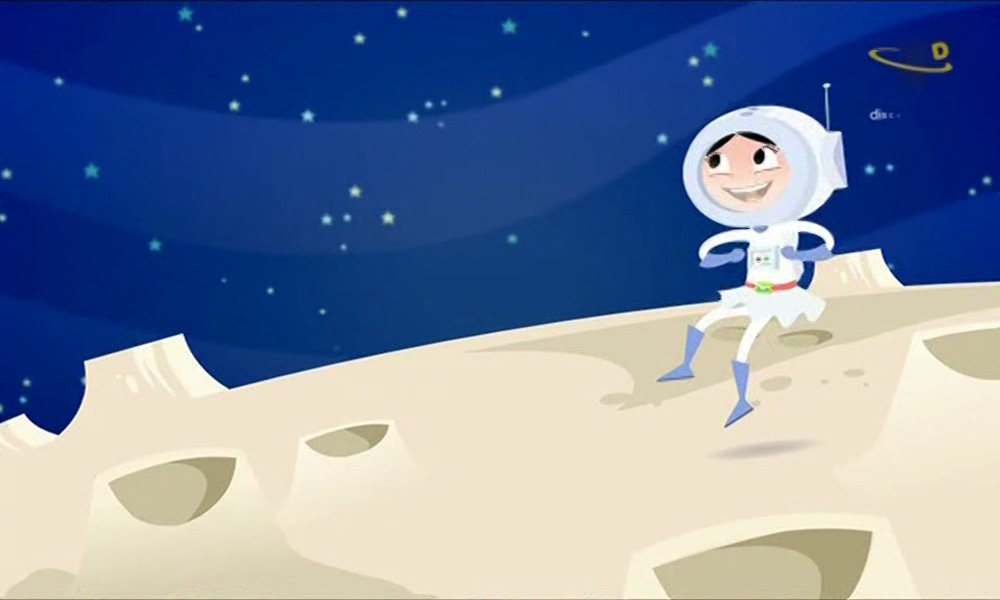
    U.S. Pay TV service Condista has acquired the first five seasons of preschool science animation series Earth to Luna! for its Spanish- and English-language service, Kids Central, from distributor Monster Entertainment. The hit international Emmy-nominated series is set to debut on the outlet in early 2020.

    A co-production with Discovery Kids Latin America, Earth to Luna! has recently sold to Radio Television Hong Kong, HornEng for VOD and DVD in Taiwan, CNC for DVD in Korea, to Azoomee and Hopster for SVOD, and to Flynas, Virgin Atlantic, Emirates, Air Azul, Aer Lingus for inflight entertainment. Discovery Kids in the Middle East and North Africa, TG4 Ireland, CJ E&M Korea’s English channel GEM, and Minika in Turkey have all recently picked up all the available seasons.

    Earth to Luna! has aired in 96 countries on channels including Sprout in the U.S. and Tiny Pop in the U.K., as well as Netflix worldwide (excluding Latin America).

    Season 6, in which Luna and her family go and live in a space station, has recently gone into production and will be completed in 2020

    Earth to Luna! follows the adventures of six-year-old Luna, who is completely, undeniably and passionately in love with science. The global science smash for preschoolers from PenGuin Animation, Latin America’s leading animation company, has inspired a special project to promote the Sustainable Development Goals of the UN, which have been designed to achieve a better and more sustainable future for all.

  • Golden Globes: ‘Missing Link’ Wins Best Animated Feature

    Golden Globes: ‘Missing Link’ Wins Best Animated Feature

    The HFPA presented the 77th Golden Globe award ceremony on Sunday night, kicking the Hollywood awards season into high gear. Ricky Gervais returned to the podium to host the celebration of feature film and television achievement, which included honoring Tom Hanks with the Cecil B. DeMille Award and Ellen DeGeneres with the Carol Burnett Award.

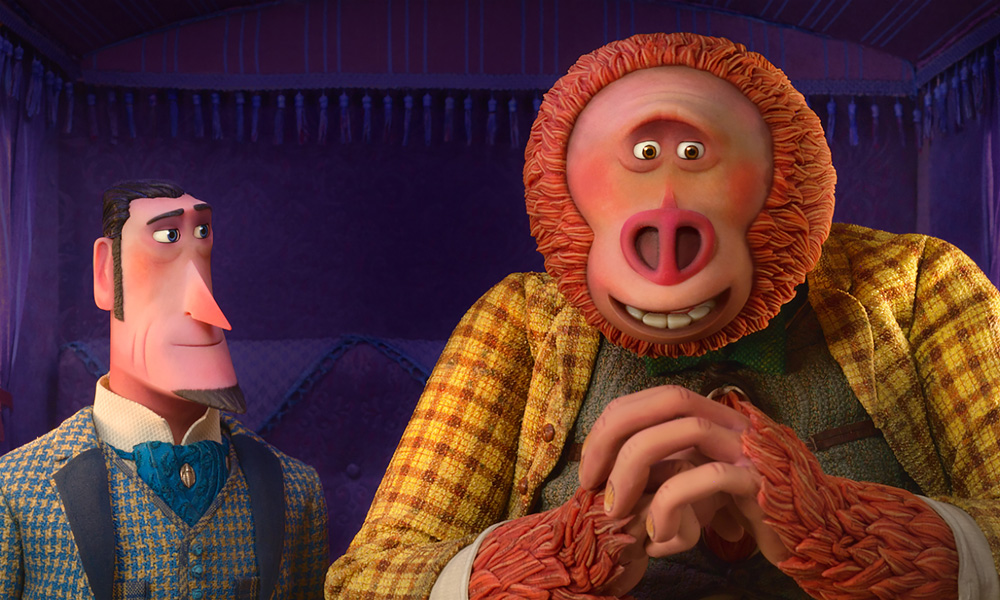
    The Best Animated Feature prize went to LAIKA’s globe trotting stop-motion adventure Missing Link, directed and written by Chris Butler. This marks the Oregon-based studio’s first Golden Globe win, despite prior nominations for Coraline, The Boxtrolls and Kubo and the Two Strings.

    Reacting to the honor, LAIKA President & CEO and producer Travis Knight, writer/director Chris Butler and producer Arianne Sutner said:

    “For a stop-motion movie to be recognized in this way, alongside such amazing animated films, means everything to the LAIKA community of animators and craftspeople. The strength of the universe of animation is its diversity – of people, of voices, and of styles. We are honored to play our small part in that. This award is not just for all the storytellers, artists, creators and performers of LAIKA who helped bring this story to life, but for all those who support stop-motion animation and original storytelling in all its forms.”

    This was quite an achievement for LAIKA’s stop-motion and CG-animated feature, which had stiff competition from Disney’s Frozen 2, Pixar’s Toy Story 4 and DreamWorks’ How to Train Your Dragon: The Hidden World.The HFPA added a twist to the category by also nominating Jon Favreau’s The Lion King , which is computer animated, but was not positioned as an animated film by Disney.

    The Golden Globes have a strong winning correlation with the Oscars animated feature picks. The same movie has won both awards 10 times since the Globe category was introduced in 2006, including in 2019 when Spider-Man: Into the Spider-Verse snagged so many awards in its web.

    Exceptions to this trend are the first year, when Globe winner Cars was passed over in favor of George Miller’s Happy Feet by the Academy; 2011, when Steven Spielberg’s The Adventures of Tintin took the Globe and Gore Verbinski’s Rango won the Oscar; and 2014, when the Globe went to DreamWorks’ How to Train Your Dragon 2 and the Oscar to Disney’s Marvel-inspired hit Big Hero 6.

    Best Animated Feature

    • Frozen 2 (Disney)
    • How to Train Your Dragon: The Hidden World (DreamWorks, Universal)
    • The Lion King (Disney)
    • WINNER Missing Link (LAIKA/Annapurna, United Artists)
    • Toy Story 4 (Disney/Pixar)

    Best Original Song

    • “Beautiful Ghosts” (Cats) Andrew Lloyd Webber, Taylor Swift
    • WINNER “I’m Gonna Love Me Again” (Rocketman) Elton John, Bernie Taupin
    • “Into the Unknown” (Frozen 2) Kristen Anderson-Lopez, Robert Lopez —
    • “Spirit” (The Lion King) Timothy McKenzie, Ilya Salmanzadeh, Beyoncé —
    • “Stand Up” (Harriet) Joshuah Brian Campbell, Cynthia Erivo
    "Missing Link" director Chris Butler and producer Arianne Sutner backstage at the Golden Globes
    Missing Link director Chris Butler and producer Arianne Sutner backstage at the Golden Globes
  • ‘Frozen II’ Snows Competition as Highest-Grossing Toon Ever

    ‘Frozen II’ Snows Competition as Highest-Grossing Toon Ever

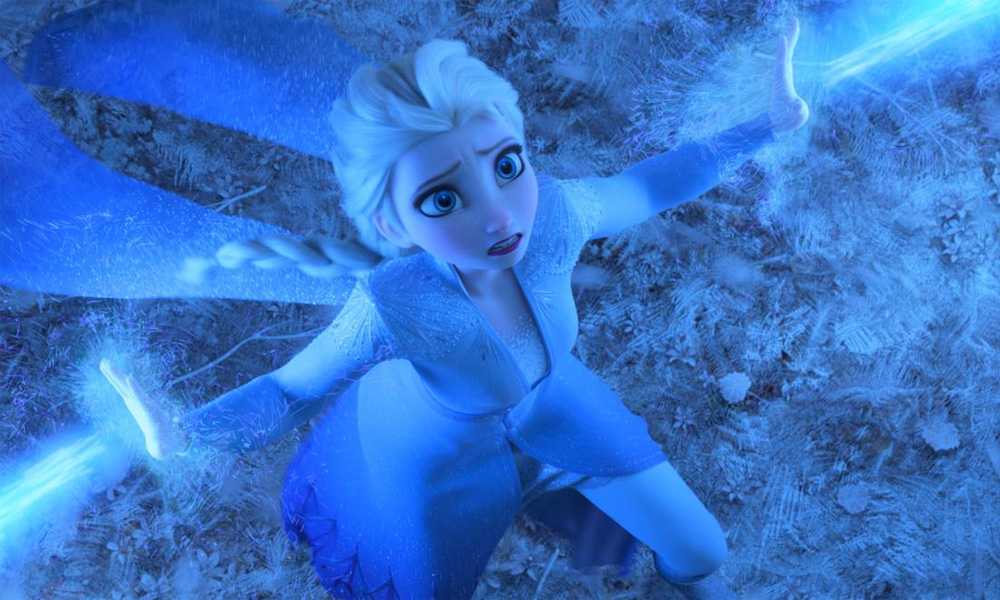
    Having rapidly skated past the $1 billion marker with its fourth weekend (the sixth Disney Studios film of the year to do so), blockbuster animated sequel Frozen II has thawed out a spot at the top of the all-time highest-grossing animated features worldwide. Directed by Jennifer Lee and Chris Buck, the pic has racked up an estimated $1.325B ($449.9M domestic, $875.3M international).

    Four out of the top five all-time animated movies are now Disney or Pixar titles, as Frozen II edged out the first Frozen ($1.281B), Incredibles 2 ($1.243B), Minions ($1.159B, Illumination/Universal) and Toy Story 4 ($1.073B).

    It should be noted that the great identity crisis film of the year, The Lion King, has $1.657B. So, the No. 1 ranking depends on your definition of “animation.”

    The film’s race to the top has been helped by a quick rollout around the world. The sequel hit $1B in less than a third of the time it took Frozen (15 weeks). The top international markets for Frozen II to date are China ($118.8M), Japan ($103.8M), Korea ($96.2M), the U.K. ($65M) and Germany ($55.1M).

    Frozen II previously set a domestic opening record for an animated November opening, as well as all-time animated openings internationally ($228.2M) and worldwide ($358.2M).

    [Source: Yahoo!]

  • Canadian Animation Veteran Blair Kitchen Passes Away at 43

    Canadian Animation Veteran Blair Kitchen Passes Away at 43

    We are deeply saddened by the untimely passing of Canadian animation veteran Blair Kitchen at age 43, early Sunday morning. The much-loved and respected animator, comic-book creator and educator died as the result of a blood clot that had developed in his brain over Christmas.

    Kitchen, who studied animation at Sheridan College, began his career as an animator on the animated series Stickin’ Around in 1997. At Yowza Animation, he worked on projects such as Kronk’s New Groove, Curious George and The 3 Wise Men. He was also a designer on shows such as Busytown Mysteries, artist on Wayside, and animator on Life’s a Zoo, A Miser Brothers’ Christmas and Glenn Martin DDS. Over the past two decades, Kitchen also worked as a storyboard artist at House of Cool, Mercury Filmworks and a stop-motion animator at Cuppa Coffee Animation. He also taught animation at Toronto’s Seneca College and was the creator of the comic books The Possum and Copy Cat for Possum Press.

    He also worked in character layout for The Ripping Friends, Amberwood’s Hoze Hounds and storyboard artist on Nelvana shows such as Spliced, Johnny Test and Scaredy Squirrel.  Most recently he was a storyboard artist on DreamWorks/Netflix series acclaimed Trollhunters: Tales of Aracadia, story artist on Fox/Blue Sky’s 2017 movie Ferdinand, storyboard artist and animator on the series Welcome to the Wayne. This past year, he contributed animation to the acclaimed Netflix series Green Eggs and Ham and was  in-house animation supervisor for the second season of the show, which is being produced at Yowza! Animation  studio in Toronto.

    Throughout the day, many animation greats left tributes on his Facebook page. Among them was Book of Life director Jorge Gutierrez who wrote:

    “I was lucky enough to have worked with Blair (through House of Cool) on both The Book of Life and Maya and The Three. His boards were always so full of life and inventive ideas. As if he became the character he was boarding with a million subtleties and insights. And his positive attitude, even on crazy days, was always infectious and welcome. Behind the scenes he would always chime in with hilarious ideas or suggestions on how to help the younger board artists in the team in Toronto. He was such a nurturing and kind mentor that I’m sure his legacy as an artist and teacher will be felt for generations to come. May we all leave a legacy like his. Gracias, hermano. RIP maestro Blair Kitchen.”

    Blair is survived by his wife, artist Rochelle Ansley Kitchen, and their three children. A special Gofundme campaign has been created to help support Blair’s family here: www.gofundme.com/f/w8hvgd-blair-kitchen

    The Possum
    The Possum
    Blair Kitchen
    Blair Kitchen
  • China’s iQIYI Sends First Original Animation ‘Spycies’ on Global Mission

    China’s iQIYI Sends First Original Animation ‘Spycies’ on Global Mission

    Leading Chinese online entertainment service iQIYI is ready to send its debut family-animated feature film Spycies to theaters at home and abroad. Produced by iQIYI Pictures, the CGI adventure will arrive in theaters across China on January 11, with subsequent releases rolling out in Europe, North America and Southeast Asia.

    Spycies revolves around an alluring and complex action-adventure embarked upon by “Spy Cat” Vladimir and “Hacker Mouse” Hector, set in a modern world where animals rules.

    To create this critter kingdom, the production team animated more than 40 species, over 90 animal characters, and more than 60 scenes. The film features endangered animals such as white rhinos and snow leopards, nationally protected animals such as lorises, and extinct animals such as mammoths. Spycies also features cutting edge effects, such as distinctive fur animations for each on-screen species based on research into the animals’ real-world physical characteristics including fur pattern, material, length and density.

    “With the superb animation effects, exciting storyline, and family-friendly themes, this film will undoubtedly succeed in delighting parents and children alike,” said Ya Ning, President of iQIYI Pictures. “The film will further be released in overseas markets, and we look forward to bringing more premium content to our global audiences in the future.”

    In 2018, Spycies was nominated by the Cannes International Film Festival’s “Annecy Goes Cannes” program based on the Annecy International Animated Film Festival’s judging panel recommendation.

    Leveraging its rich experience in adapting its premium IP across multiple entertainment formats, iQIYI is developing merchandise such as mystery toy boxes, steam eye masks, luggage cases and snacks around Spycies.

    Spycies
    Spycies
  • Patricia Alice Albrecht, Voice of ‘Jem’s Pizzazz, Has Died

    Patricia Alice Albrecht, Voice of ‘Jem’s Pizzazz, Has Died

    Actress, voice over artist and poet Patricia Alice Albrecht, known to a generation of fans as the voice of green-haired troublemaker Pizzazz in animated series Jem and the Holograms, died on December 25, 2019, at her home in Nashville, Tennessee. The news was shared by her friend and co-star, Samantha Newark (voice of Jem), in a heartfelt Instagram post.

    Newark added that in lieu of flowers, Albrecht’s wish was for donations to be made to Free for Life International (https://freeforlifeintl.org), a Nashville-based organization dedicated to finding and helping victims and survivors of human trafficking.


    Albrecht was born in Detroit, Michigan and earned a BFA in Theater from Wayne State University, according to her IMDb bio. She played roles in live-action TV series and movies including Remington Steele and Midnight Madness and in the late ‘70s/early ‘80s before landing the role of Phyllis “Pizzazz” Gabor on Jem and the Holograms (1985-88). The character was the spoiled, mischief-making lead singer of Holograms rival band The Misfits, and was often the source of peril for the popular toy tie-in cartoon from Sunbow, Marvel and Hasbro.

    Into the mid-’90s, Albrecht continued to provide voices for animated projects, with repeated appearances on The New Yogi Bear Show, Snorks and New Kids on the Block a well as gigs on Tom & Jerry Kids, Droopy: Master Detective, Batman: The Animated Series and The Sylvester & Tweety Mysteries.

    Albrecht eventually moved to Nashville, where she pursued writing, forming a group and encouraging other aspiring scribes. Her fiction and poetry have appeared in literary anthology Wind Eyes, A Woman’s Reader and Writing Source, The Crone Chronicles, National Library of Poetry and others. She also published poetry chapbooks The Value of Sacrifice, about healing from breast cancer; The Shade of a Forest, about late-life motherhood, and The Season of Dying Mothers. In 2009, Albrecht recorded a poetry CD A Touch of Pizzazz for fans of Jem.

    H/T ComicBook.com.

    Patricia Alice Albrecht
    Patricia Alice Albrecht
  • Oscar Watch: Tunes that Makes Toons Fly

    Oscar Watch: Tunes that Makes Toons Fly

    ***This article originally appeared in the February ‘20 issue of Animation Magazine (No. 297)***

    Feature animation and music have been Oscar-night dates for some eight decades now, and the musical scores for many of this year’s top nomination hopefuls are finding their voices — literally. One of this year’s strong contenders, Disney’s Frozen II, features seven new songs by Kristen Anderson-Lopez and Robert Lopez (2014 winners for Best Song), and returning composer Christophe Beck once more called upon the Norwegian female chorus Cantus to flavor and develop his score. “Similar to how Elsa and Anna have grown up since the last film, the new score has also matured and introduces more sophisticated musical concepts and thematic elements,” Beck stated.

    Other composers are making vocals integral parts of their scores as well. For the indie contender Buñuel in the Labyrinth of the Turtles, distributed by GKIDS, a chorus of voices was employed for a key scene set in a school, in which the impoverished children sing to the main character, shattering his emotional dam. Given the Spanish production’s limited budget, composer Arturo Cardelús came up with an ingenious scheme to record the music: he asked a friend at London’s Royal Academy of Music to make the choral passage part of the current curriculum. After weeks of rehearsals, the students were taken to Abbey Road Studios to record the piece … for class credit. “They were 19, 20 [years old] and they were all so excited,” Cardelús says. “It was a win-win.”

    Budget considerations were far less of a problem for 2011 nominee John Powell, whose score for DreamWorks’ How to Train Your Dragon: The Hidden World also drew upon choral passages. “Between Dragons 2 and 3 I wrote an album of choral music, including a requiem,” Powell says. “I spent a lot of time working on my choral writing, and I think it improved number three.” Powell convinced British musician Eric Whitacre, who pioneered the concept of virtual choirs, to provide the voices and conduct the session. “He has his own ensemble of musicians he calls on when he’s doing recordings and concerts in Europe,” Powell notes. “I saw what a real choral conductor can bring out in a choir: they reacted to every little nuance of his face and fingers.”

    Powell also collaborated with Icelandic singer/songwriter Jónsi for the music underscoring the hidden world sequence. “We always said his voice is the voice that you recognize as the dragon’s voice, so I wanted to do something in that world that would be a metaphor for the dragon’s home,” Powell says.

    John Powell
    John Powell
    How to Train Your Dragon: The Hidden World
    How to Train Your Dragon: The Hidden World

    To Shangri-La and Beyond

    In crafting the score for LAIKA’s Missing Link, two-time Oscar nominee Carter Burwell turned to a choir to heighten the aural awe in the climactic sequence set in Shangri-La. “The whole movie is about getting to this place,” Burwell says, “so when we finally get there I thought it was important to have some new, breathtaking elements in the score as a way of amping up the orchestration.” The Shangri La sequence features more brass instrumentation, including a bass trombone, which Burwell says “delivers a lot of the very low, profound bass notes.”

    Overall the score relies heavily on strings to emphasize the story’s Britishness (it involves a Victorian-era explorer who finds and befriends a homesick Yeti). “[Writer/director Chris Butler] really wanted the film to look and feel like an old, classic British production,” the composer states. “He wanted a traditional sound in the score, but it also harkens back to travelogue adventure films, so as you go through each geographical area you lend some of the instrumental flavor from that area. When we’re in the Pacific Northwest we hear guitar or Native American winds, when you’re in India you hear the sitar, and when you get to the Himalayas there are some wind pipes. This is probably the first time I’ve had such variety in one film.”

    Carter Burwell
    Carter Burwell
    Missing Link
    Missing Link

    For Rupert Gregson-Williams, composer of DreamWorks/Pearl Studios’ Abominable, employing human voices into the score was a way to add majesty to the sound. “Because of the epic size, especially when we get into the Himalayas, I really couldn’t resist the choir,” he says. “It’s a good emotional tool, but it wasn’t a representation of any particular character.”

    There was one exception to that: Gregson-Williams’ own voice is the representation of the Everest, the soulful Yeti befriended in the film by a young girl named Yi. The composer provided the creature’s signature humming for the production scratch track, only to see it retained in the final product. “I actually tried hard to get the producers to use someone else but they kept coming back and saying, ‘But we like it!’” Gregson-Williams says. “I’d say, ‘There’s someone else out there who could do a better job than me,’ but it stuck in the film.” While he is actually pleased to have his voice is so completely integrated into the film, the composer/hummer confesses that he had a little help. “I’ve been asked if I had that sort of range, and my answer is, obviously I don’t,” he says. “But there was a useful bit of software to help me get down there.”

    Even more important, though, was creating the violin solo played by Yi, which serves as the emotional core of the score, if not the film itself. “I met with [writer/director Jill Culton] two-and-a-half years ago and we spoke about how the character felt about her violin, her connection to her father, and this tune that she was always reaching to play — a melody that he had taught or had played to her when she was little,” he says. “We spoke about different scenes where she would play or quote part of it until it was fully realized at the Leshan Buddha, about three-quarters of the way through the film.”

    Because the melody was so integral to the story, Gregson-Williams composed it very early on and gave it to the animators, who drew upon video of violinist Charlene Huang to animate the hand movements. “The attention to detail from the animators was amazing,” he relates. “Normally in these scenarios, even in live action, you see people playing the fiddle and it’s quite embarrassing. They were terrific in animating all the fingerings and bowings as accurately as possible.”

    First-Hand Experience

    Animators were also concerned with finger positions for the French animated film I Lost My Body, from Xilam Animation, but for an entirely different reason. The festival favorite — released in the U.S. by Netflix — is about an ambulatory severed hand. While using voices to represent a hand would seem incongruous, composer Dan Levy concentrated on different instrumentation and chord progressions to highlight different moods and emotions. “When I started to compose some music for the movie, the storyboard and animatic were very abstract, so I had to use my imagination to envision what the final film would look like,” Levy says. “I wanted the music to help guide the audience through the layers of the film with ease. I used the flute to represent childhood, the arpeggio to represent the mechanism of destiny, and strings to represent the love story.”

    Dan Levy
    Dan Levy
    I Lost My Body
    I Lost My Body

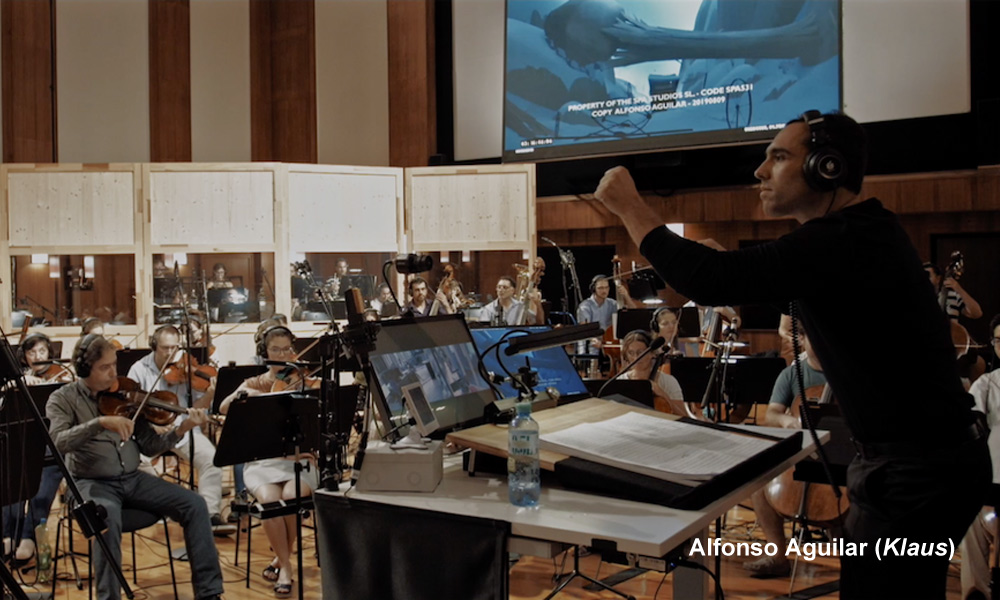
    SPA Animation’s Klaus, which is also being distributed by Netflix, offered composer Alfonso G. Aguilar his first experience scoring an animated film, as well as the chance to employ a super-sized orchestra. “It was huge,” Aguilar says, “it was 145 people! [The standard-sized orchestra for a film is 65-to-85 musicians.] What I did was mix many wind instruments so that they sound as if they’re only one, and we got that ‘Northern’ sound.” To highlight that sound Aguilar employed an instrument that is very unusual for a symphonic orchestra: an ocarina. “The ocarina represents the wind,” he explains, “which is Lydia, Klaus’s wife. It sounds amazing because it is very organic and warm, and feels like if you were blowing into your hands.”

    The composer sites a sequence in which the frosty townspeople began to thaw a bit as the biggest challenge of the film. “It’s the point in which the town starts evolving from the evil and the war ambiance that they had into kindness,” he says. “The name of the sequence is ‘Changes,’ and it’s funny because we changed the cue 42 times until we arrived at the concept.” Aguilar adds that he rewrote one of the discarded versions to create a separate suite that is not in the film, but will be included on the album.

    Klaus
    Klaus

    Any discussion of music scoring has to include serial nominee Randy Newman (winner for Monsters, Inc. and Toy Story 3), who is back this year for Disney/Pixar’s Toy Story 4. Newman’s biggest competition for that, however, is not any of the other animated feature composers, but rather himself, given the buzz (pun intended) his score for the live-action dramedy Marriage Story has been generating.

    The time between the announcement of 2020 nominees and the Oscar-cast on February 9 is shorter than ever, a little under a month. It’s safe to bet, though, that some animation composers will spend those weeks singing. Maybe even humming.

    Academy Award nominations voting is now open until January 7. Nominations will be announced on Monday, Jan. 13. The 92nd Oscars will be held on Sunday, Feb. 9.

    The following songs from animated and related pictures have made the Oscar shortlist in the Best Original Song category:

    * Nominated for the Golden Globe for Best Original Song

  • Two Studio Ghibli Movies in the Works in 2020

    Iconic Japanese animation house Studio Ghibli has announced that 2020 will be an extra productive year, with two film projects underway as well as live shows and the ongoing work on Ghibli Park (set to open outside Nagoya, Japan in 2022). The update was shared with a charming “Year of the Rat” illustration by studio co-founder and creative force, Hayao Miyazaki.

    One of the movies in the pipeline is How Do You Live? (Kimi-tachi wa Dou Ikuru ka), directed by Miyazaki and inspired by the early 20th century book by Genzaburo Yoshino. Officially announced in 2017 — bringing the animation legend out of retirement, again — the project is proceeding at a very careful pace, without a deadline, with producer Toshio Suzuki saying during an NHK interview last month that the film was about 15% completed after three-plus years. The 78-year-old helmer used to direct seven to 10 minutes of animation a month, Suzuki explained, but now completes about one minute in the same amount of time.

    How Do You Live? had been expected to debut timed to the 2020 Summer Olympics in Tokyo, but the film doesn’t have an official release date yet. Miyazaki’s last “final” feature animation, Oscar-nominated The Wind Rises, was released in 2013/14.

    No additional information on the second film project was included in the announcement, but the studio could be referring to the CG-animated film being directed by Miyazaki’s son Goro Miyazaki (Tales from Earthsea, From Up on Poppy Hill), also announced in 2017.

    The announcement (in Japanese) reads:

    Happy New Year to all.

    Thank you for always supporting Studio Ghibli.

    Last year was not a bad year for Studio Ghibli, because it was possible to share the news of our Kabuki stage production and other works; the official announcement of Ghibli Park, and active overseas development. However, disasters such as typhoons and heavy rains in Japan are continuing, and it is painful to think that there are a lot of people who are forced to have a hard life even at this time. We would like to express our sincere condolences to those affected by the damage, and pray for the rebuilding of our lives as soon as possible.

    By the way, the zodiac sign of 2020 is “rat”. Rats are symbolic of prosperity because of their prolific reproduction, and are also said to be the angels of the god of fertility. I hope that the stagnant mood of society will be renewed, and that we will have a year of hope.

    Studio Ghibli continues to work on two new films. Also, Ghibli Park has started in earnest, so we hope to be able to deliver a lot of excitement this year.

    H/T BoredPanda

    [Sources: Ghibli, Anime News Network]

    Ghibli 2020
    Ghibli 2020
  • ‘The Witcher’: Crafting All Creatures Great and Monstrous

    ‘The Witcher’: Crafting All Creatures Great and Monstrous

    ***This article originally ran in the February ‘20 issue of Animation Magazine (No. 297)***

    If you guessed that a much-anticipated series based on a supernatural breed of monster hunters would have spectacular visual effects, you would be absolutely right. The new Netflix series The Witcher, which is based on Polish author Adrzej Sapkowski’s popular novels, stars Henry Cavill as Geralt the monster hunter, Anya Chalotra as a sorceress named Yennefer and Freya Allan as the mysterious mutant Ciri.

    Showrunner Lauren Schmidt Hissrich (The Umbrella Academy) made a conscious decision to draw inspiration from the source material rather than the internationally renowned video games adapted from the fantasy drama. Given the nature of the story, which takes place in a vast and varied medieval land inhabited by sorcerers, elves and fantastical creatures, production VFX supervisor Julian Parry (Vikings) had to deliver a wide array of digital augmentation for each of Season One’s eight episodes.

    “When I read the script, what came to mind was how similar it was to the scale of something like The Lord of the Rings,” notes Parry. “You’re dealing with the same aspirations and high expectations of what people are currently seeing on television and in the movies. Part of my job is to try to make sure that we’re doing visual effects that can be managed, service the script, and are achievable within a television schedule.”

    The first season features just under 2,000 visual effects shots created over a period of six months by Cinesite, Framestore, One of Us, NVIZ and Platige Image. “We had to be aware of the episodic deadlines, needed to implement designs as early as possible, and got the vendors working on the shots as soon as we could.”

    Julian Parry
    Julian Parry

    Creatures with Many Legs

    First order of business was to conduct a limited amount of research. “I didn’t want to be contaminated by any outside influence, but instead decided to stay focused on how Lauren interpreted the books,” remarks Parry. “I drew upon my rich background in dealing with creatures as well as European and Slavic folklore in which The Witcher is set.” Outside of a couple of early designs produced by the art department, the visual effects department looked after the creation of the creatures. “Sometimes the creature design is all well and good until you want to make it work, let alone fight.”

    A mixture of practical and digital effects was utilized to bring the creatures to life and have them interact with the cast members Cavill, Allan and Chalotra. “Occasionally, we went pure CGI and had a proxy device for the actors.”

    In the opening sequence of the first episode, Geralt of Rivia is in a swamp battling a massive arachnoid known as the Kikimora. “A lot of our creatures have numerous legs!” laughs Parry. “In the case of the Kikimora, director Alik Sakharov (Game of Thrones) wanted it to be like a fighting machine. It’s tricky to keep the creature balanced and attacking at the same time. We knew from the script what type of creature it needed to be, did some quick motion studies and shoehorned those all into place to come up with the final animation.”

    “Henry is not on a greenscreen stage,” says Parry. “So, it’s about making sure that the actor is engaged. On The Witcher, there are a handful of greenscreen shots. The rest of it is in a real set or environment.”

    The Witcher
    The Witcher

    Outside of the Kikimora, all of the other creatures were integrated into live-action plates shot on location. “Creatures will be seen in forests or caves or running across the desert,”he notes. “Each creature brings their own set of challenges. We had many Ghouls to deal with. They come from underground, like moles. We had to work out the animation of how the Ghouls were going to appear out of the ground, run around and move. This was in episode eight, we were running out of time so needed to be efficient in the way it was going to be shot and be post produced. We went for a halfway point between motion-capture and prosthetics. The stunt team arranged for small performers to perform the role of the Ghouls to interact with Henry, and then we pulled the production plate apart and applied our Ghoul over the top.”

    The series also features a fascinating new breed of insect. “When that came up in the script, I asked, ‘What’s a Roachhound? Are we doing a mangy dog?’ Lauren said, ‘No. We want it to be half cockroach and half dog.’ The company One of Us took on that particular project. That was straightforward because we wanted to have a cockroach move with the nuances of a hound.”

    The Witcher
    The Witcher
    The Witcher
    The Witcher

    Building a Magical Realm

    As expected, magic is interwoven into the narrative. “Lauren has built a clever arc for the magic,” observes Parry. “The power of Yennefer is hinted to in a couple of scenes. It is alluded that she might have the capability to hold energy. She stumbles across her power early on but not in a destructive way. She learns how to portal. The character arc grows stronger as the episodes continue on and has a catastrophic end use for that special energy and power that she has.”

    A major plotline involves Ciri learning that she not just of royal blood but has magical abilities that make her an extremely powerful weapon. “Ciri has a similar arc,” explains Parry. “She is not aware of her powers, which are alluded to, and in the end also has a chaotic moment. This is what will ultimately bring Geralt of Rivia, Yennefer and Ciri together. The magic was dealt with in a sophisticated and chic way. Lauren wanted the magic to speak to the drama. For example, Mousesack [Adam Levy] is not a flash-bang-wallop kind of guy; his magic is grounded in nature.”

    Another VFX highlight involves a desert sequence, where Yennefer conjures a sand portal. “Any environment that she went into the portal would affect one of the main elements that was within that place,” explains the VFX supervisor. “When I read that in the script I thought, ‘This could be one of our Achilles’ heels.’ What is a portal? It’s not a fixed thing. Everyone has their own idea. We had a good four months of researching the looks of our various portals. Different characters within the show have their signature portal. We didn’t want to do the water ripple effect or even a ring, which reminded us too much of Stargate.”

    The Witcher
    The Witcher

    Another one of the show’s memorable images is that of a cosmic tree. “This is one of Ciri’s future visions and was a digital matte painting that was taken on by Platige Image in Poland. It was a production shot plate from the Canary Islands in the sand dunes. The only thing that is CGI is the tree itself.”

    Meanwhile, it was the the team and VFX house Cinesite that looked after the epic battles taking place between warring kingdoms. “You have to be smart how you design the shot. The foreground is kept as real as possible and rely on the background becoming a simulation,” says Parry.

    “There weren’t as many set extensions that you might think,” he adds. “I was a big advocate for building and getting in the real environment as possible. But the location work was not easy. We were shooting in Budapest in the mid-winter. It got down to minus 12 or maybe even lower. That was challenging for the crew.”

    The Witcher
    The Witcher
    The Witcher
    The Witcher

    The scripts also proved to be quite ambitious. “I knew that it was going to be challenging from the onset because the expectation on the page was very evident,” says Parry. “Almost every minute of this series is a visual treat and that involves visual effects. I hope that viewers like the creatures and some of the gore is unusual and unique for a TV series. The trebuchet fire is beautiful. I just want people to enjoy The Witcher the way that I’ve enjoyed making the show.”

    The first season of The Witcher is now streaming on Netflix globally. According to the streaming service, the show was its sixth most watched offering of 2019, although it only debuted on December 20th.

    The Witcher
    The Witcher
  • Heritage Expands Weekly Comics, Animation & Art Auctions to 2 Days

    Heritage Expands Weekly Comics, Animation & Art Auctions to 2 Days

    Steady growth and the opportunity to reach a wider audience have prompted Heritage Auctions to change the format of its Weekly Comics, Animation and Comic Art online auctions into two-day events.

    Under the new format, comic books will be offered on Sundays in each week’s sale. Original art, animation art and video games will be offered on Mondays. The new format will allow auction sessions to finish earlier, a benefit that will be particularly appealing to collectors in later time zones.

    “We made this change to address the one downside of having so much quality material, namely that the live sessions had been ending a bit too late in the evening,” Heritage Auctions Vice President Barry Sandoval said. “Of course, as always, bidders can place their secret maximum bids anytime during the preceding week.”

    The weekly online comics auctions have enjoyed enormous success in recent years, totaling $18,901,941 in 2019 – an average of $363,000 per week. That included a record $573,095 realized in the Sunday Internet Comics, Animation & Art auction that closed March 3, 2019.

    Visit Heritage Auctions’ Sunday & Monday Comics, Animation & Art Weekly Online Auction #122001 to browse high-resolution images of the auction’s 1,044 lots of comic books, original comic book art and memorabilia. Bidding opens at 6 p.m. (Central Time) on HA.com.

    Heritage Auctions is the largest fine art and collectibles auction house founded in the United States, and the world’s largest collectibles auctioneer. Heritage maintains offices in New York, Dallas, Beverly Hills, San Francisco, Chicago, Palm Beach, London, Paris, Geneva, Amsterdam and Hong Kong.

    The Internet’s most popular auction-house website, HA.com has over 1,250,000 registered bidder-members and searchable free archives of five million past auction records with prices realized, descriptions and enlargeable photos. Follow Heritage on Facebook (/HeritageAuctions) and Twitter (@HeritageAuction) for updates.

    Michigan J. Frog
    Michigan J. Frog
  • RR Auction Offers Rare Mary Blair, Eyvind Earle and Mickey Mouse Art

    RR Auction Offers Rare Mary Blair, Eyvind Earle and Mickey Mouse Art

    Some rare and remarkable concept art from Disney classics such as Fantasia, Alice in Wonderland, Cinderella, Snow White and the Seven Dwarfs and Sleeping Beauty are currently available for sale through Boston-based RR Auction, which prides itself on selling historic material, thoroughly examined by in-house experts and third-party authenticators. Fans are advised to act quickly because the auction closes on Wednesday, January 8.

    Highlights of this session include:

    • Mickey Mouse production cel and production background from Fantasia
    • 25 production cels from Alice in Wonderland
    • Mary Blair concept painting of Peter Pan, John, Wendy, Michael and Tinker Bell from Peter Pan
    • Mary Blair concept paintings from Cinderella and Alice in Wonderland
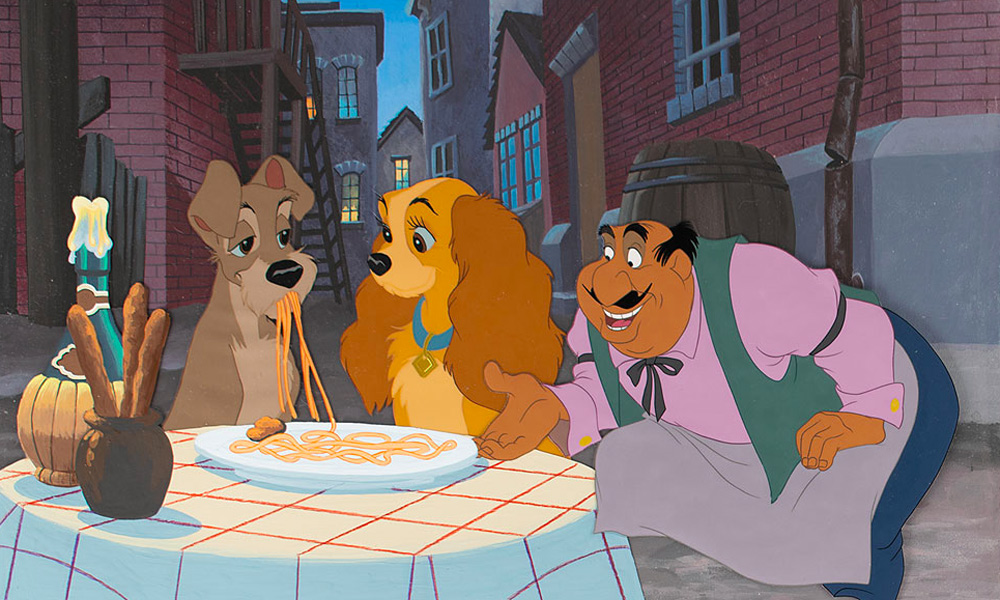
    • Five Eyvind Earle’s concept paintings from Sleeping Beauty and Lady and the Tramp
    • Donald Duck and José Carioca production cel from Saludos Amigos signed by Walt Disney
    • Ariel production cel from The Little Mermaid
    • A huge Charlie Brown drawing by Charles M. Schulz
    • The Evil Queen production cel from Snow White and the Seven Dwarfs
    • A rare four-piece production cel display from Pinocchio
    • Mickey Mouse and Kat Nipp custom-painted cel and production background from The Karnival Kid
    • Life-size Goofy statues once displayed at Epcot
    • A Disney Studios’ Duckster award from 1952

    “As the next generation of collectors enter the marketplace, quality, iconic animation cels are seen as the blue chip pieces,” says RR Auction COO Bobby Eaton. “Accelerating values bring out great consignments from our long time client base. It’s exciting to see a healthy marketplace where everyone is happy.

    Eaton says Mickey Mouse, Fantasia, the Evil Queen and The Little Mermaid have a strong emotional connection to everyone. “That’s the reason why people collect art, because it touches us in such a personal way. Having these emotions portrayed in their original forms and concepts is hard to resist,” he notes.

    When asked about the best strategy to bid on items, Eaton says, “I always tell people to only buy what they love …. And set a budget!”

    To register to bid, visit www.rrauction.com. Browse all comic art and animation auction lots here.

    Full catalog available online.

    Peanuts
    Peanuts
    Lady and the Tramp
    Lady and the Tramp
    Saludos Amigos
    Saludos Amigos
    Alice in Wonderland
    Alice in Wonderland
    The Karnival
    The Karnival
    Fantasia
    Fantasia
  • Box Office Winners of 2019

    Box Office Winners of 2019

    The top 10 animated and VFX-fueled big screen blockbusters that closed out the decade with a box-office bang!

    Animated Movies

    1. The Lion King (Disney) $543,638,043
    2. Toy Story 4 (Disney.Pixar) $434,038,008
    3. Frozen II (Disney) $421,682,862
    4. How to Train Your Dragon 3 (DreamWorks) $160,799,505
    5. Secret Life of Pets 2 (Illumination) $158,257,265
    6. The Lego Movie 2: The Second Part (Warner Bros) $105,806,508
    7. The Addams Family (MGM/Cinesite) $97, 185,807
    8. Spider-Man: Into the Spider-Verse (Sony) $82,094,865
    9. Abominable (DreamWorks/Pearl) $60,646,745
    10. Wonder Park (Paramount) $45, 216,793

    CG-Driven Movies

    1. Avengers: Endgame (Disney) $858,373,000
    2. Captain Marvel (Disney) $426,829,839
    3. Spider-Man: Far From Home (Sony) $390,532,085
    4. Star Wars: Episode IX (Disney) $362,186,406
    5. Aladdin (Disney) $355,559,216
    6. It: Chapter Two (Warner Bros.) $211,593,228
    7. Us (Universal) $175,005,930
    8. Fast & Furious: Hobbs & Shaw (Universal) $173, 810,100
    9. John Wick 3: Parabellum (Lionsgate) $171,015,687
    10. Pokemon: Detective Pikachu (Warner Bros) $144,105,346

    Figures are domestic B.O., per BoxOfficeMojo.

  • News Bytes: Artios Awards Nominees, Disney+ 2020 First Look, KyoAni Attack In-Depth & More

    News Bytes: Artios Awards Nominees, Disney+ 2020 First Look, KyoAni Attack In-Depth & More

    The Great Animation Strike
    Kristin Hunt for JSTOR Daily brings us back to the 1930s, when Sadie Bodin and other fed up artists took a stand for fair and safe practices, unionization and recognition.

    In Memoriam: Gerry Alanguilan
    The Filipino comic-book writer and artist, creator of Wasted, died last month at age 51. Winning the note of Western comics titans like Neil Gaiman and Warren Ellis, Alanguilan also published Johnny Balbona, Humanis Rex!, Timawa and Where Bold Stars Go to Die in the Philippines, as well as contributing to Siglo and Filipino Komiks anthologies. He gained further notoriety for his work on U.S. titles X-Men, Wolverine, Superman: Birthright and more.

    Two Pokémon Games Hatch Exclusively on Facebook
    Pokémon Tower Battle, developed by Bombay Play, sees players battle by stacking Pokémon against one another to create towers. As players discover, catch and level-up rare Pokémon, they can compete in real time against friends or across a global leaderboard. (Available worldwide.)

    Pokémon Medallion Battle, developed by GCTurbo, is a digital card battle strategy game. Trainers collect, battle and evolve Pokémon in medallion form and embark on a journey with their companions to win gym badges and complete their Pokédex. New Pokémon are introduced every month. (Currently available in Asia-Pacific territories, excluding Vietnam and Oceania.)

    Tragedy in an Animation Utopia: Horror, Heartbreak and Mystery after an Arson Massacre

    Scott Johnson and Patrick Brzeski’s feature piece for The Hollywood Reporter is a must-read; a comprehensive, sympathetic and probing excavation of the devastating July 18 attack on Japanese studio Kyoto Animation.

    WATCH: What’s Coming to Disney+ in 2020
    From Toy Story 4 and Aladdin to Lizzie McGuire and Marvel’s WandaVision, here’s a quick peek at the blockbuster films and intriguing originals coming to the streamer in the new year.

    Casting Society of American Announces Nominees for 35th Artios Awards

    “The art of casting for film continued to shine this year, as represented in this noteworthy list of projects. Joining our television and theatre nominees, these talented Casting Directors exemplify the range of skills and expertise throughout our craft,” said Russell Boast, President, CSA. “The 35th Artios Awards will put a spotlight on the year’s outstanding contributions from our members as we collectively build on this year’s achievements for an even stronger future.”

    Winners will be announced Thursday, January 30 at ceremonies in Los Angeles (hosted by Ron Funches), New York City (hosted by Michelle Buteau) and London.

    Television Animation nominees:

    • Big Mouth – Julie Ashton-Barson
    • Bob’s Burgers – Julie Ashton-Barson
    • BoJack Horseman – Linda Lamontagne
    • She-Ra and the Princesses of Power – Ania O’Hare
    • SpongeBob SquarePants – Shannon Reed, Shiondre Austin

    Film Animation nominees:

    • Abominable – Christi Soper Hilt
    • Frozen 2 – Jamie Sparer Roberts, Sarah Raoufpur (Associate)
    • The Lion King – Sarah Halley Finn, Jason B. Stamey (Associate)
    • How to Train Your Dragon: The Hidden World – Christi Soper Hilt
    • Toy Story 4 – Kevin Reher, Natalie Lyon

    Zeitgeist Award nominees:

    • Avengers: End Game – Sarah Halley Finn, Chase Paris (Location Casting), Tara Feldstein Bennett (Location Casting), Jason B. Stamey (Associate)
    • IT Chapter 2 – Rich Delia, Stephanie Gorin (Location Casting), Coco Kleppinger (Associate)
    • Star Wars: The Rise of Skywalker – Nina Gold, April Webster, Alyssa Weisberg, Angela Young (Associate)
    Pokemon: Tower Battle, Pokemon: Medallion Battle
    Pokemon: Tower Battle, Pokemon: Medallion Battle
    Kyoto Animation
    Kyoto Animation
    Gerry Alanguilan
    Gerry Alanguilan
  • Trailer: Star-Powered ‘Swift’ Soars with Shout! Studios

    Trailer: Star-Powered ‘Swift’ Soars with Shout! Studios

    Next month, Shout! Studios will invite family audiences to take flight with an uplifting CG-animated journey in Swift — a story about standing up for what you believe and finding your place in the world.

    Featuring the voices of Oscar winner Kate Winslet (Titanic, Mary and the Witch’s Flower) as Blanche, four-time Oscar nominee Willem Dafoe (The Lighthouse, Finding Dory) as Yves, and Josh Keaton (Voltron: Legendary Defender) as Manou, Swift is ready to hatch in select theaters and across digital and On Demand outlets on February 21.

    Swift is directed and produced by by Andrea Block and Christian Haas, written by Block and Axel Melzener based on an original story by Haas. Associate producers are LUXX Studios (Haas, Block), Ambient & Friends (Sebastian Riemen, Bernd Bohnert) and Herold Studios (Wolfgang Herold).

    For showtimes and more information, visit www.SwiftTheMovie.com.

    Swift
    Swift
    Swift
    Swift
    Swift
    Swift
  • Hasbro Completes $3.8B eOne Acquisition

    Hasbro Completes $3.8B eOne Acquisition

    Hasbro, Inc. today announced that it has completed its previously announced acquisition of Entertainment One Ltd. (eOne), adding beloved global brands including Peppa Pig and PJ Masks to its purview and expanding storytelling through immersive entertainment experiences.

    “We are excited about what we can do together and see tremendous opportunity for shareholder value creation through this acquisition,” said Brian Goldner, Hasbro Chairman & CEO. “Our businesses are highly complementary with substantial synergies and a great cultural fit. The addition of eOne accelerates our blueprint strategy by expanding our brand portfolio with eOne’s beloved global preschool brands, adding proven TV and film expertise, and creating additional opportunities for long-term profitable growth. We are pleased to welcome the incredibly talented eOne team to our Company.”

    Darren Throop, President & CEO of eOne, will report to Goldner. In addition, eOne’s Olivier Dumont, President, Family & Brands; Steve Bertram, President, Film & Television; and Chris Taylor, Global President, Music, will also be joining Hasbro, reporting to Throop.

    The all-cash transaction is valued at approximately £2.9 billion, based on the consideration of £5.60 per common share of eOne. Converted at a rate of 1.31 USD/GBP on December 30, 2019, the total cash consideration was approximately US$3.8 billion. Hasbro also expects to redeem eOne’s outstanding senior secured notes and to pay off the debt outstanding under eOne’s revolving credit facility, which together represent approximately £0.6 billion of eOne’s indebtedness.

    The announcement made early this week comes a little less than a month before the deadline set by the U.K. antitrust body the Competition and Markets Authority to decide whether to trigger an in-depth review of the deal. If a “substantial lessening of competition” in the U.K. is feared, the Authority will begin a 24-week investigation.

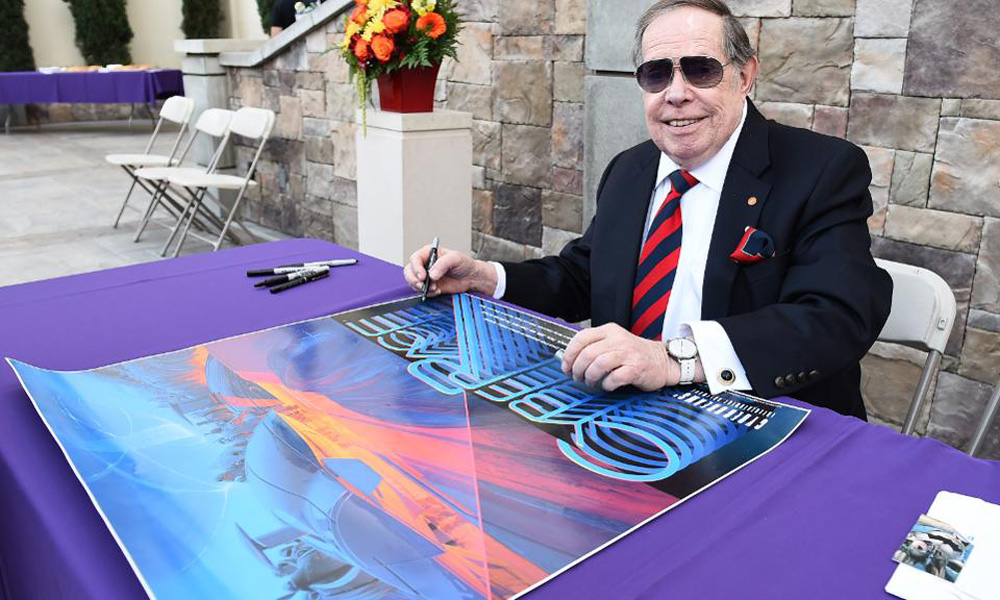
  • Visionary Sci-Fi Concept Artist Syd Mead Dies Age 86

    Visionary Sci-Fi Concept Artist Syd Mead Dies Age 86

    Syd Mead, influential conceptual artist and designer whose works made up the aesthetic framework of iconic films like Tron, Blade Runner and Alien, died December 30 at age 86. Mead’s husband and business partner, Roger Servick, told The Hollywood Reporter that the visionary artist died at their home in Pasadena, having lived with lymphoma for three years.

    Born in St. Paul, Minnesota in 1933, Mead began drawing at a young age, and was drawn into the world of science fiction through pulp magazines such as Buck Rogers and Flash Gordon. After graduating from high school in Colorado Springs, Colorado, Mead served in the U.S. Army for three years and then enrolled at the Art Center School in Los Angeles (now Art Center College of Design, Pasadena).

    Upon graduating in 1959, Mead was recruited as an industrial designer at Ford Motor Co.’s Advanced Styling Studio, relocating to Detroit. He left after two years to illustrate books and industrial catalogs before launching his own company in 1970. Through the next two decades, Mead travelled between the U.S. and Europe, designing and illustrating for clients like Philips Electronics, Sony, Bandai and Honda, as well as creating architectural renderings for Intercontinental Hotels and others.

    During this time, Mead’s designs caught Hollywood’s attention. He was production illustrator on Star Trek: The Motion Picture, concept artist for 1982’s TRON and coined the term “visual futurist” to describe his work on Blade Runner, released the same year. He went on to create whole worlds and contribute designs for 2010 (1984), Short Circuit (1986), Aliens (1986), Solar Crisis (1990), The Timekeeper (1992), Timecop (1994), Johnny Mnemonic (1995), Mission to Mars (2000), Mission: Impossible III (2006), Elysium (2013), Tomorrowland (2015) and Blade Runner 2049 (2017). Mead also worked Japanese animated projects Yamato 2520 (1994) — redesigning the titular ship — and Turn-A Gundam (1999). A documentary of his career, Visual Futurist, was released in 2007.

    Mead has been named the winner of the 2020 William Cameron Menzies Award from the Art Directors Guild (having previously shared the Excellence in Production Design honor for Blade Runner 2049 as well as being nominated for Elysium). He would have accepted the award during a ceremony February 1. Mead was also the recipient of the Visual Effects Society Visionary Award in 2016, as well as an Honorary Award from Sitges in 2007. He announced his retirement in September 2019 after a six-decade career.

    Mead is survived by Servick, by his sister, Peggy, and several nieces and nephews.

    [Source: Hollywood Reporter]

  • Something to Say About Danny Aiello

    Something to Say About Danny Aiello

    On May 22, 2019, I had the honor of joining Danny Aiello at the Hoboken International Film Festival for the premiere of an animated film that had been a life’s journey. He is the voice actor in my animated short Nothing to Say (NTS), which tells the story of a turtle at a zoo who is confronted to conform to a closed society, exposing themes of exile and being a refuge in a land that provides for the body at the cost of the soul. This interaction with Aiello was profound, as I had recorded him for this very film back in 2001. Little did I know the release of this film 18 years later would be one of Danny’s final creative works before he passed away in December.

    Most people will remember Aiello’s masterful work as an actor, playing prominent and iconic roles in live-action films, working with Hollywood titans such as Spike Lee, Norman Jewison, Woody Allen, Robert Altman and Francis Ford Coppola. Aside from his Oscar worthy performances on screen, he was also an incredibly talented voice actor.

    Starting as a student film in 1997, NTS was re-designed in 1999 as a studio project at ILM, where I worked as an animator. After layoffs at the studio, it became an independent film with a small crew in Hamilton, Ontario.

    Aiello was approached at an animation convention by my brother (one of the film’s producers), Billie Mintz, and we recorded the track in New Jersey. I was thrilled beyond imagination. But also nervous as hell; fairly fresh out of college — not only had I never directed anything professionally, I certainly had not worked with actors, especially ones as iconic as Danny Aiello.

    Danny Aiello and Aubry Mintz
    Danny Aiello and Aubry Mintz

    When we recorded, Danny was aware of my nervousness and made every effort to make me feel comfortable. After some small talk, Danny began asking pointed questions about the script/poem. I shared how I visualized the film by showing him some artwork that Geoff Donovan (the film’s art director) and I had created. Danny began performing lines of gold right out of the gate, presenting a variety of approaches, transitioning in and out of three characters. His acting seemed like magic, as I witnessed him play from an objective narrator to a light, happy, rhythmic zookeeper who grew in rage as a mute turtle refuses to conform to his ideals.

    After a few takes, it was clear he was not yet finding the character he wanted. He backed away from the microphone clearly frustrated, and tried a new approach. He moved around the room and began humming a song to himself and snapping his fingers, losing himself in a song. It emerges as Sinatra’s “It’s All Right with Me”. He was searching for something, finding his own groove and rhythm. After circling the room, he changed his posture, and his expressions migrated from concentration to an easy smile. He returned to the microphone, straightened up, reached his arms from side to side in a grand posture and with a chuckle belted out his lines perfectly. It was the moment he found his character and his recognition was astonishing to watch. I heard the character for the first time. It was a true gift watching this veteran get into character, reminding me that true art takes work — even for seasoned pros.

    Nothing to Say
    Nothing to Say

    Danny had been reading for over an hour and approaching an important line that the turtle spoke. He wasn’t quite getting what I needed, and I belted out the line the way I thought it might go, which is something every directing book tells you not to do with actors. Aiello stopped what he was doing, took a long pause and straightened up, and said, “You want me to read it that way? The way you just did it?” I gulped slowly, looking up at this giant, “Uhhh yyyyeahhh???” He took a breath, smiled, and slowly walked over to me, putting his arm around my shoulder and said, “As an actor, I don’t usually do it that way…”

    The room was silent. I imagined him turning into his character Sal the pizza man (Do the Right Thing) right in front of me, grabbing his bat from behind the bar to chase me out of the recording studio. The people in the booth were equally nervous. Danny continued, “…But for this… for this we have to! C’mon everybody!!!” He belts out a laugh and gives me a big hug. It was these gentle reminders and charisma that people seem to love about Danny. He was a pro without any ego.

    Danny Aiello and Aubry Mintz
    Aubry Mintz and Danny Aiello

    Based on the recorded tapes of Aiello’s performance, we were able to choose from a library of movements he portrayed for each character. Broad open, embracing poses for the Zookeeper when he was broadcasting his seemingly positive leadership style, quickly changed to hunched over snapping chaotic jerks, seething with anger, uncovering a manic controlling dictator. Then his slow, methodical, pain-filled emotional performance for the turtle was enough for anyone’s heart to well, as you experience the trauma exude from his vocal cords. Danny gave everything to this performance — watching his posture change form was a lesson in acting mastery.

    When world events changed all of our lives on September 11, 2001, I donned my headphones, listening to Danny lament with the turtle’s story. All I could do was interpret how I was feeling on paper. Danny’s emotional vocal journey allowed my pencil to speak for me – creating a moody, dark, sad and scary sequence that seemed fitting for the events. The loss the turtle felt echoed the collective defeat the world was feeling when the towers fell. Not long after this event, the film went on hiatus. but this encounter with Danny Aiello was the glue that held it all together in the back of our minds until the story would emerge once again.

    It was 12 years later when I received a phone call from Mark Jones, the Chair of animation arts at Seneca College in Toronto. He heard about an urban legend that I had an unfinished film with Aiello attached to it and would like to help us finish it. Seneca’s Summer Institute was no stranger to co-producing films, they were the school that animated on Chris Landreth’s Oscar winning short Ryan and on his Annecy Grand Prix film Subconscious Password. Nothing to Say returned to production in the summer of 2015. Working between Canada, California and Australia, we managed to keep three simultaneously in production until its completion in April 2019.

    Nothing to Say
    Nothing to Say

    At the night of the premiere in Hoboken in 2019, I asked Danny his thoughts on the finished film. I was floored by his response. He said Nothing to Say gave him the emotional feelings of losing friends/loved ones on September 11, 2001. I had not spoken with Danny since the recording, there was no way for him to know my influence from the tragedy. It was amazing to see his connection to the events tie to his perception of this film.

    This film is a message of tolerance and educating to instill empathy about displaced people after a tragedy. I was touched deeply that this resonated with Danny in such a prophetic way.

    As I write this article, I just left the Palm Springs International Animation Festival, where I screened the film. Listening to Danny Aiello tonight, just a few days after his death, moved me more than it has in 18 years. I’ve listened to this track over 1,000 times, but tonight was different. I could hear Aiello’s voice and I could see his smile. How he worked with me, so diligent and determined to get it right. I can’t begin to express what an impact Danny Aiello had on me. His generosity to give a 25-year old from Canada his time and talent, taking direction like a pro from the greenest kid since Kermit the Frog, will never be forgotten. Thank you for reading my words and giving them meaning and respect. Thank you for giving me the performance of a lifetime. Thank you for a lifetime of inspiration.

    Rest in peace, Danny.

    Nothing to Say – 30 second clip “This is Your Last Chance” from Aubry Mintz on Vimeo.

    You can also watch the entire film at myhero.com/nothing-to-say

    Password: Turtle

    Animation Credits:
    Painted Backgrounds: Geoff Donovan and Anda Chitescu
    Animation: Aubry Mintz, Oshi Wanigasekera, Edward Han, George Fleming, Rocco Pisani
    Effects Animation: Darren Donovan and Edward Han
    Ink and Paint: George Fleming, Kelly Juarez, Jules NG, Ryan Chu, Rodrigo Gonzalez

    Aubry J. Mintz has worked as a feature animator at Industrial Light & Magic and Square USA and an award-winning freelance animation director for clients such as Smirnoff, McDonalds, MuchMusic, General Mills and the Canadian rock band Rush. He produced the animated pilot Airship Dracula for Rides TV with the Canadian rock group The Sadies and Juno-winning animation director Michael Roberts, and directed the award-winning animated short Nothing to Say narrated by Danny Aiello and co-produced by the Oscar-winning Seneca Institute in Canada. Mintz is also co-author for the Focal Press book Ideas for the Animated Short 2nd Edition (Focal Press) and has presented his storytelling findings to audiences throughout the U.S. and Canada. Mintz is currently the Director of the School of Art at California State University Long Beach.